
Wrought Iron Fence Gate Installation: Hinges, Latches, and Hardware Explained
Most fence problems start at the gate. A wrought iron fence gate takes more abuse than any other part of the fence. It swings hundreds of times a year, carries its own weight on two hinges, and gets slammed by wind, kids, and hurried hands. When homeowners in Akron tell us a fence "failed," the story usually starts with a gate that sags, a latch that will not catch, or a hinge screw that pulled loose. The panels along the property line are often still fine. Understanding how to choose the right wrought iron gate hardware is essential to preventing these common failures.
That is why this guide focuses on the hardware. Hinges, latches, locks, and the posts that hold them decide whether a wrought iron gate works smoothly for twenty years or becomes the thing you fight with every morning. If you are replacing an old fence, or putting up a new one along a property line you want settled once and for all, the gate hardware deserves as much attention as the fence itself.
Why the Gate Is the Weak Point of Any Iron Fence
A fence panel just stands there. A gate moves. That single difference explains most of what goes wrong.
Every time a wrought iron fence gate swings, the full weight of the steel hangs off the hinge-side post. Over years, that load works on the post, the hinge pins, and the fasteners. Add Akron's freeze-thaw cycles, which shift posts set in clay-heavy soil, and a gate that was hung plumb in June can drag the ground by March.
The latch side has its own failure mode. If the gate sags even a half inch, the latch bar misses the striker. People start lifting the gate to close it, which strains the hinges further. The cycle feeds itself until someone props the gate shut with a brick.
Here is the practical takeaway: when you compare fence quotes, ask specifically how the installer handles gate posts and hardware. A low number that treats the gate like just another panel usually costs more later in fence repair calls.
What Goes Into Wrought Iron Gate Hardware: The Components That Matter
A wrought iron fence gate is only as good as four pieces of hardware: the hinges, the latch, the post anchoring, and any lock or closer you add. Get those four right and the gate outlasts the paint. Get one wrong and you will notice within a year.
Hinges: Where the Whole Load Lives
Hinges carry everything. On an ornamental steel or iron gate, you will see a few common types:
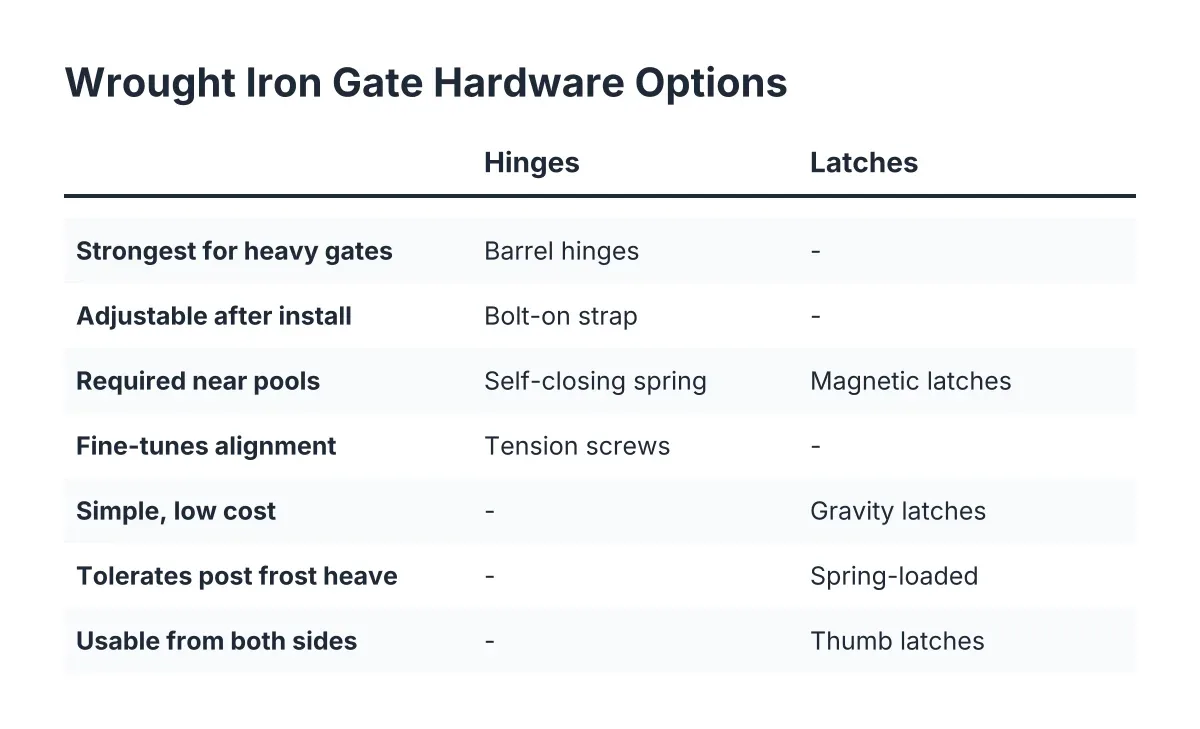
- Barrel hinges, often welded to the post and gate frame. These are the strongest option for heavy gates because the weld spreads the load instead of relying on screws.
- Bolt-on strap hinges, which clamp or bolt to the post. These allow adjustment after installation, useful where seasonal soil movement shifts the post slightly.
- Self-closing spring hinges, required in many places around pools. They pull the gate shut behind you.
- Adjustable hinges with tension screws, which let an installer fine-tune gate alignment without rehanging anything.
The hinge side of a gate needs reinforcement far more than the latch side. Latch hardware rarely tears out of a post; hinge hardware does, because it carries live weight in motion. On an iron gate, that means the hinge post should be heavier, set deeper, and often set in more concrete than a standard line post.
One habit of careful installers is worth knowing even if you never hang a gate yourself. Setting the latch striker in place before hanging the gate gives the gate a fixed target. The striker position effectively self-aligns the gate during hanging, so the gap, the swing, and the latch all line up on the first try instead of the third.
Latches: The Part You Touch Every Day
The latch is the handshake of the fence. A wrought iron fence gate latch comes in several styles, and the right choice depends on who uses the gate and how.
- Gravity latches drop a bar into a catch on their own. Simple, cheap, and fine for garden gates.
- Spring-loaded latches snap shut with more force and tolerate a little misalignment, which matters on lots where frost heave nudges posts each winter.
- Magnetic latches use a magnet to pull the latch bolt closed. Many pool codes favor these because they close reliably and mount high, out of a child's reach.
- Thumb latches work from both sides of the gate, handy for a gate you pass through with full hands.
If the gate sits on a shared boundary, think about which side the latch faces. A latch your neighbor can reach reads as friendly. A latch only you can operate reads as a statement. On property-line fences, small hardware choices carry social weight, and it costs nothing to think it through before installation day.
Locks: Security Without Fighting the Gate
A wrought iron fence gate lock ranges from a simple padlock eye on the latch to a keyed lockset built into the gate frame. For most Akron backyards, a lockable gravity or magnetic latch covers it. For a front walk gate or a gate facing an alley, a keyed lock or a key-coded mechanical lock adds real security without wiring anything.
Whatever you choose, the lock should never be the thing holding the gate shut against sag. If you need the lock to force the gate closed, the problem is alignment, not security.
Posts and Anchoring: The Hardware You Cannot See
The best hinges on earth fail on a bad post. In Akron, that usually means clay. Clay-heavy soil holds water, freezes, expands, and pushes posts upward or sideways a little each winter. A gate post that moves an inch throws the whole gate out of square.
Therefore, gate posts for an iron gate should go deeper than line posts, below the local frost depth, with concrete footings shaped to resist heave. This is the single biggest difference between a gate that still swings true in year fifteen and one that drags by year three. It is also the part a homeowner cannot inspect after the fact, which is why it belongs on your list of questions before you sign anything.
A Hypothetical Akron Gate, Start to Finish
Suppose a homeowner in Highland Square has a wood fence that finally gave out after fifteen winters. The posts rotted at the ground line, the gate has hung from one hinge since fall, and a new neighbor just asked, politely but pointedly, whose fence it is. The homeowner decides to replace it with ornamental iron along the back property line, with one walk gate to the driveway.
In that scenario, here is roughly how the gate portion of the job runs. First, the property line gets confirmed, by existing survey pins if they can be found, or by a new survey if they cannot. The fence line gets set a few inches inside the line so there is never an argument about encroachment. Next, the crew sets the two gate posts first, deeper and heavier than the rest, and lets the concrete cure before hanging anything.
Then comes the hardware sequence. The striker goes on the latch post. The gate gets squared and hung against that fixed target, hinges adjusted until the gap is even top to bottom. Additionally, the latch closes with a clean click, no lifting, no shoulder check. Furthermore, the homeowner now has a gate on a documented line, with paperwork to point to if the question ever comes up again. That last part, for a lot of Akron homeowners, is worth as much as the steel.
What Professional Wrought Iron Gate Installation Includes
A full installation of a wrought iron fence gate by a fence company normally covers the gate posts, footings, the gate itself, hinges, latch, and final alignment. It should also include confirming where the fence can legally sit relative to the property line. Items that often cost extra include surveys, old fence removal, locks beyond a standard latch, and automatic closers.
When you review a fence estimate, look for these items spelled out:
- Layout and line confirmation. Who locates the property line, and what happens if survey pins are missing.
- Gate post specification. Depth, footing size, and whether gate posts differ from line posts. In clay soil, they should.
- Hardware list. Hinge type, latch type, and lock, named specifically rather than "standard hardware."
- Tear-out and haul-away. Whether removing the old fence is included.
- Adjustment terms. Whether the installer will realign the gate if it shifts after the first winter.
For context on overall budget, HomeAdvisor data shows homeowners typically spend between $1,743 and $4,431 on a new fence installation, averaging $3,059 nationally. Redfin reports a similar national average of about $3,200, varying by material and fence type. Wrought iron tends toward the higher end of material costs, and a custom gate adds to that, so treat those national figures as a floor for planning, not a quote. The only real number for your yard comes from someone measuring your yard.
On timing, a straightforward gate and fence section usually spans a few working days, with gate posts set first so footings can cure before the gate hangs. Weather and ground conditions stretch that; frozen clay in January is slower digging than dry soil in September.
Repair or Replace: Reading the Signs on an Aging Gate
Not every sagging gate needs a new fence. Many wrought iron fence gate repair jobs come down to hardware, and hardware is replaceable.
A gate worth repairing usually shows one of these: a worn hinge pin, a bent latch bar, loose hinge bolts, or surface rust on the frame. New wrought iron fence gate hardware, a hinge swap, or a latch replacement brings that gate back for a fraction of replacement cost.
However, some signs point past repair. If the hinge post itself leans or rocks, the footing has failed, and no hinge will fix that. If rust has eaten through the frame at the welds, the gate has lost its structure. And if the whole fence line shows the same post movement, the ground is telling you the original installation did not account for frost depth. At that point, spending on hardware is patching a boat with a hole in the hull.
A quick honest trade-off: wrought iron asks more of you than aluminum. It can rust where the coating chips, so plan on touching up paint every few years, especially at hinge welds where movement wears the finish first. If zero maintenance matters more to you than the look and heft of true iron, an aluminum fence with similar styling is the fairer comparison, and a good installer will say so.
DIY or Hire It Out: Where the Line Sits
Plenty of gate work sits comfortably in a homeowner's hands. Tightening hinge bolts, swapping a gravity latch, adjusting a tension hinge, and repainting chips are all a Saturday with basic tools. A wrought iron fence gate kit for a garden opening between existing masonry columns is also a reasonable project if the mounting surfaces are solid.
Call a pro for anything involving the posts or the line. That includes:
- Setting or resetting gate posts, since footing depth in clay soil decides everything downstream.
- Welded hinge replacement, which needs equipment and skill most garages lack.
- Any gate on or near a disputed property line, where placement mistakes turn into neighbor problems.
- Pool gates, where self-closing and self-latching hardware must meet code, and getting it wrong carries liability.
In addition, call sooner rather than later if a gate post visibly leans after a freeze, or if a heavy gate hangs by one working hinge. A loose iron gate is heavy enough to injure a child or pet when it finally lets go.
Choosing an Installer for an Iron Gate in Akron
Searching for wrought iron fence installers near me returns a long list. Three questions separate the careful ones quickly.
First, ask how they set gate posts differently from line posts, and how deep they go in clay soil. The answer should mention frost depth without you prompting it. Second, ask exactly which hinges and latch come with the gate, by type, not just "heavy duty." Third, ask how they handle the property line, including what happens if your survey markers are missing. A straightforward installer explains their layout process plainly; a vague answer here predicts vague work later.
A fair fence quote itemizes the gate, its posts, and its hardware separately from the fence run. That lets you compare material options honestly and see where the money actually goes. It also protects you; if a quote buries the gate inside a lump sum, you cannot tell whether the hinge post is built for the load or treated like every other post.
Getting It Done Before the Ground Freezes
The gate is the handshake of your fence, and the hardware is what makes that handshake firm. Hinges sized for the load, a latch that catches without a fight, and gate posts set below Akron's frost depth turn a wrought iron gate from a maintenance headache into the part of the fence you never think about.
If you are weighing repair against replacement, or you want a fence set clearly on your side of the line with a gate that will still swing true in ten winters, Akron Fence Co can walk your property line, look at the ground you are actually building on, and give you a clear estimate with the gate hardware spelled out. Reach out when you are ready, and bring your questions; plain answers about posts, hinges, and property lines are the whole point.
If you need fence installation, Akron Fence Co can help.
Prefer to talk it through? Call (330) 302-2470 — a quick call is usually the fastest way to get a straight answer for your situation.