
Ornamental Iron Fence Parts Explained: Scrollwork, Finials, and Hardware
When a storm drops a branch on an iron fence, the hardest part is often naming what broke. Knowing your ornamental iron fence parts, the pickets, rails, finials, scrollwork, and gate hardware, helps you describe the damage, get a fair fence estimate, and avoid paying for a full replacement when a section repair will do. This guide walks Akron homeowners through each part step by step, so you can inspect the fence, source what you need, and know when to call a fence company.
Whether your fence is true wrought iron on an older Akron bungalow lot or a modern welded steel ornamental fence, the parts work the same way. Here is how to work through it.
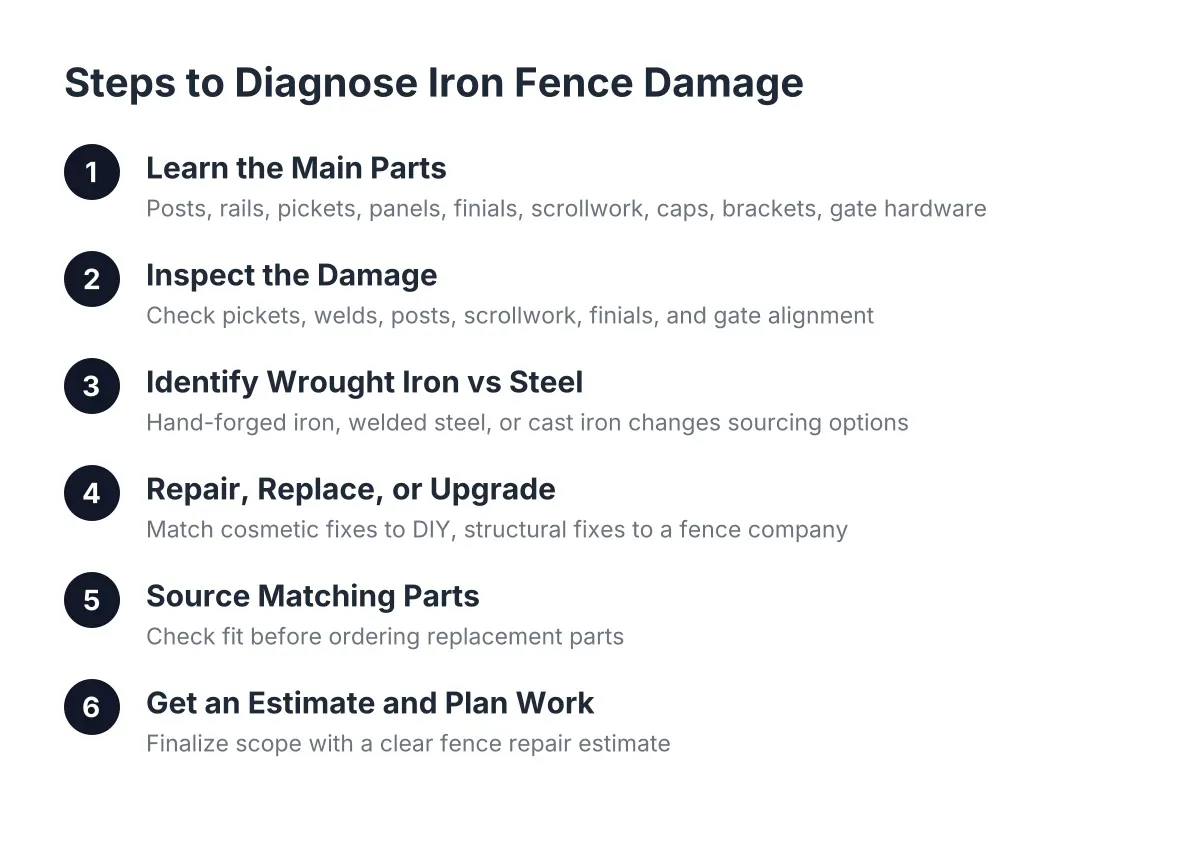
Step 1: Learn the Names of the Main Ornamental Iron Fence Parts
Start by learning the vocabulary. Every quote, parts catalog, and repair conversation uses these terms, and using them correctly saves you time on the phone.
- Posts: The vertical anchors set in concrete. Terminal posts sit at ends, corners, and gates. Line posts run between them.
- Rails: The horizontal members that tie posts together. Most ornamental fences have a top and bottom rail; taller styles add a third.
- Pickets: The vertical bars between rails. These take the most damage from falling limbs.
- Panels: A pre-assembled section of rails and pickets that spans post to post, usually six or eight feet.
- Finials: The decorative tips on pickets and posts. Common shapes include spear points, ball caps, and fleur-de-lis.
- Scrollwork: The curved decorative ironwork, often mounted between pickets or along the top rail.
- Post caps: Covers that keep water out of hollow posts. A missing cap lets water in, and water that freezes inside a post splits it.
- Brackets and mounts: The hardware that attaches panels to posts, either welded or bolted.
- Gate hardware: Hinges, latches, drop rods, and gate frames.
Write these down before you inspect the damage. A call that says "I need two eight-foot panels, one line post, and a replacement spear finial" gets you a real answer. "My fence is broken" gets you a site visit and a wait.
Step 2: Inspect the Damage Part by Part
Next, walk the fence line with that list in hand. After a storm, do not stop at the obvious break. Impact travels through welded fencing, so check both directions from the hit.
Look for these specific failures:
- Bent or snapped pickets. If only pickets are bent, a repair may straighten or replace them without touching the panel.
- Cracked welds where pickets meet rails. Shine a flashlight along each rail. Hairline weld cracks rust fast once the coating breaks.
- Leaning or shifted posts. Grab each post near the damage and push. Movement at the base means the concrete footing cracked or the post heaved. In Akron's clay soil, freeze-thaw cycles work on footings every winter, and a storm impact can finish what frost heave started.
- Broken scrollwork or missing finials. These are cosmetic, but note them now so the repair matches.
- Gate sag or latch misalignment. If the fence took a hit near the gate, the gate post may have shifted enough that the latch no longer catches. That matters tonight if a dog is in the yard.
Photograph everything, including close-ups of part connections and a wide shot showing how many panels are affected. Your insurance adjuster and your fence estimate both need these photos.
Step 3: Separate True Wrought Iron Parts from Modern Steel
This step decides where your parts come from. True wrought iron is hand-forged and mostly found on fences from the early 1900s, common around Akron's older platted neighborhoods. Modern "wrought iron style" fences are welded steel or aluminum with a powder coat finish.
Here is a quick test. True wrought iron shows hammer marks, slight irregularities between pickets, and solid bar stock. Modern steel ornamental fencing has uniform hollow pickets and consistent welds. Cast iron fence parts, a third category, show mold seams and break rather than bend; cast iron is common on finials and decorative post caps even on otherwise steel fences.
Why it matters: modern steel panels and parts are stocked and ordered from standard catalogs. True wrought iron and cast iron ornamental fence parts often need a fabricator to match, which adds time and cost. If you have a genuine wrought iron fence with hand-forged scrollwork, expect a custom repair rather than an off-the-shelf part swap. That is a case where a professional assessment is worth it before you order anything; a mismatched modern panel bolted into a century-old fence is obvious from the street.
Step 4: Decide Which Parts to Repair, Replace, or Upgrade
Now match each damaged item to the right fix. A good rule: cosmetic parts are homeowner-friendly, structural parts are not.
You can usually handle yourself:
- Replacing a missing post cap or screw-on finial
- Touching up chipped coating with rust-inhibiting paint to stop corrosion
- Tightening bracket bolts on a bolted panel system
- Adjusting a gate latch that sits slightly off
Call a fence company for:
- Any post that moves at the base. Resetting a post in Akron clay means digging out the old footing and setting the new one below frost depth, and getting that wrong means the fence leans again by spring.
- Cracked welds on rails or panels. Field welding on coated steel needs the coating ground back, welded, and refinished or the repair rusts out.
- Full panel replacement, since panels must align with existing post spacing and height.
- Gate rehangs where the post shifted. The gate is the part of the fence you touch every day, and it is the least forgiving of a sloppy fix.
For example, suppose a homeowner in Goodyear Heights has a maple limb take out two panels and bend a line post, and the dog is now on a tie-out. In that scenario, a sensible fix is two matching panels, one reset post, and a handful of finials, not a new fence for the whole yard. A repair-focused fence company should quote exactly that scope. If every answer steers toward full replacement when only two panels failed, get a second fence estimate.
Step 5: Source Matching Parts and Check Fit Before Ordering
Before any parts order, measure three things: picket spacing (center to center), rail height from grade, and panel length post to post. Ornamental fencing is not standardized across manufacturers, and a panel that is off by half an inch in picket spacing will never look right next to the originals.
Search terms like "wrought iron fence parts near me" mostly surface national catalogs and supply houses. Those work for common finials, post caps, and brackets. However, panels and scrollwork are where matching gets hard, especially on older fences. A local installer who works with ornamental iron fence parts suppliers can often identify the manufacturer from a photo and order the exact panel, which beats guessing from a parts catalog.
One honest trade-off: if your fence style was discontinued, you may face a choice between a close-but-not-exact match on the damaged run or replacing a longer stretch for a uniform look. Installers often put the non-matching or shortened sections in the least visible part of the yard and keep original full panels along the street side. Ask about that option before you commit either way.
Step 6: Get a Clear Estimate and Plan the Work
Finally, turn your inspection into a scoped request. When you call for a fence quote, list the parts by name: how many panels, posts, finials, and what the gate is doing. Ask these three questions:
- Do you repair individual sections, or only replace full fences?
- Will the replacement parts match my existing panels, and can you confirm from photos first?
- How will you set or reset the posts for Akron's clay soil and frost movement?
A fair quote itemizes parts and labor separately, so you can see what the panels cost versus the post work. Be cautious of any estimate that lumps everything into one number with no breakdown. For context on scale, according to HomeAdvisor, homeowners typically spend between $1,743 and $4,431 on a new fence installation, averaging $3,059 nationally; a parts-level repair on two or three panels should land well under a full-replacement figure, though the exact cost depends on whether parts are stock or custom.
On timing, stock steel parts can often be installed within a short window once they arrive. Custom-fabricated wrought iron or cast iron pieces take longer because someone has to make them. If security is the immediate problem, ask the installer about a temporary fix, such as securing the gap with a chain link section, until the matching ornamental parts come in.
Storm damage to an iron fence feels bigger than it usually is. Once you can name the parts, inspect them, and scope the fix, you are in control of the repair instead of reacting to it. If your fence took a hit and you want a straightforward assessment of which parts can be saved and which need replacing, Akron Fence Co handles ornamental fence repair and installation across the Akron area and can put a clear estimate on exactly the sections that failed.
If you need fence installation, Akron Fence Co can help.
Prefer to talk it through? Call (330) 302-2470 — a quick call is usually the fastest way to get a straight answer for your situation.