
How Freeze-Thaw Cycles Affect Vinyl Fence Posts in Akron, Ohio
If you are collecting fence quotes in Akron, you have probably heard an installer mention frost heave or clay soil. There is a reason for that. The way freeze thaw cycles affect vinyl fence posts is the single biggest factor in whether your fence stands straight in ten years or leans by year three. Understanding how frost heave affects fence posts, particularly with Akron's challenging soil conditions, is essential to making an informed decision. Frost heave and fence posts are critical concerns when the ground shifts with winter freeze-thaw cycles. The panels get the attention in showrooms, but the posts and the ground they sit in decide how long the fence lasts.
This guide explains what actually happens underground in a Northeast Ohio winter, how a vinyl fence post should be set to handle it, and what questions to ask when you compare bids. If you are getting three or four fence estimates before you commit, this is the background that lets you tell a careful installer from a fast one.
Why Vinyl Fence Posts Are the Whole Ballgame
A vinyl fence is only as strong as its posts. The panels, rails, and pickets all hang off those posts; the posts are the foundation of the system. Vinyl itself handles cold weather well. It does not rot like a wood fence post, and it does not rust like untreated steel. Many wood fences fail from the bottom up; the panels look fine after repainting while the posts rot at the soil line.
However, vinyl's durability above ground does not protect it from what happens below ground. If the footing under a vinyl post moves, the post moves with it. The panel then racks, the gate stops latching, and the whole run starts to wave. That movement in Akron comes mostly from one source: water in clay soil that freezes, expands, and pushes.
So when you compare quotes for vinyl fence installation, you are not really comparing panels. Most vinyl panels from reputable manufacturers perform about the same. You are comparing how each fence company plans to set posts in Akron's ground, and that is where the bids separate.
How Freeze-Thaw Cycles Affect Fence Posts in Clay Soil
Freeze-thaw cycles affect fence posts by moving the ground they sit in. When water in the soil freezes, it expands. In clay-heavy soil like much of Akron's, that expansion pushes upward and sideways against anything buried in it, including fence post footings. When the ground thaws, it softens and settles, often not back to exactly where it started.
Here is the mechanism in plain terms. Clay holds water. Sandy soil drains, but clay traps moisture around a post footing like a wet sponge. When temperatures drop below freezing, that trapped water turns to ice and takes up more space. The expanding soil grips the footing and can lift it, a process called frost heave. Then a February warm spell thaws the top layer while the deeper soil stays frozen, and the cycle repeats.
One hard freeze is not the problem. The problem is the repetition. Akron winters do not freeze once in December and thaw once in March. The ground freezes and thaws over and over through the season, and every cycle is another chance for a shallow or poorly shaped footing to ratchet upward. A post that lifts a half inch one winter and another half inch the next is visibly leaning within a few years.
This is why a fence that looks perfect in October can look tired by April. The freeze thaw cycles affect the footing all winter, out of sight, and the lean shows up when the ground finally settles in spring.
Why Akron's Ground Makes Frost Heave and Fence Posts Worse
Two local conditions amplify the effect. First, the clay content. Clay soils shift more with moisture than well-draining soils, so the same winter produces more post movement here than it would in a sandy region. Second, the lot history. Older platted city lots around Akron's bungalow neighborhoods often have fill soil, buried debris, or old footings near the property line, and those inconsistencies make post holes behave unpredictably.
Newer suburban parcels have their own quirk: graded and compacted fill that holds water in pockets. None of this makes a straight vinyl fence impossible. It just means the post-setting method matters more here than in milder climates, and a bid written for easy ground may not hold up in Akron ground.
Setting Vinyl Posts to Survive Frost Heave and Freeze-Thaw Movement
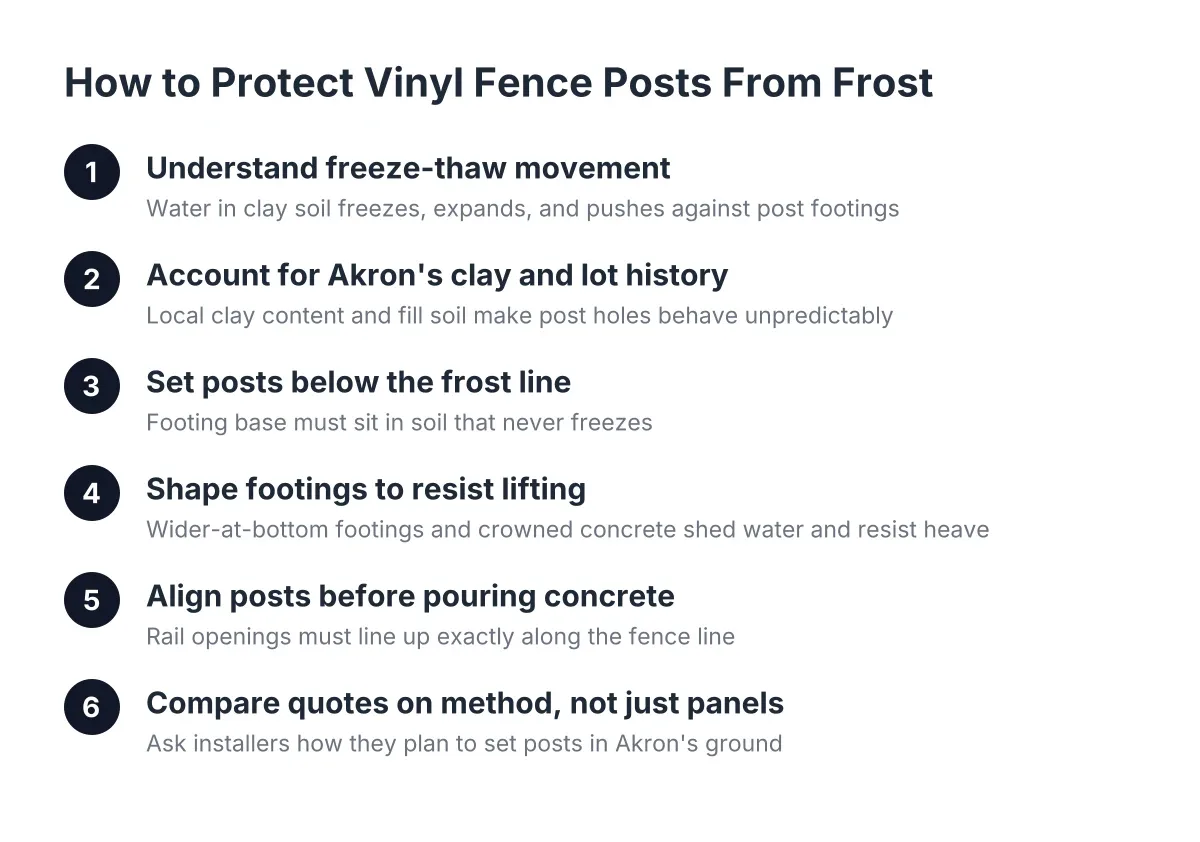
The defense against frost heave is depth, footing shape, and drainage. A vinyl post set correctly for Akron conditions goes below the frost line, sits in a footing shaped so the ground cannot grip and lift it, and sheds water instead of collecting it. Each of those three details is something you can ask about when comparing fence quotes.
Depth comes first. The footing needs to reach below the depth where the ground freezes, so the base of the footing sits in soil that never turns to ice. A footing that bottoms out in the freeze zone will get pushed from below every winter. Digging deeper costs more labor per hole, which is one honest reason two fence estimates for the same yard can differ.
Footing shape matters almost as much. A footing that is wider at the bottom than at the top resists lifting, because the frozen soil cannot slide it upward. A footing poured in a sloppy hole with a mushroom top does the opposite; it gives the freezing soil a ledge to push against. Good crews also crown the concrete at the surface so water runs away from the post instead of pooling around it. When frost heave pressures push against poorly shaped footings, the results become visible within just a few seasons.
Alignment is the detail that separates careful work from fast work. On a vinyl fence, the rail openings in each post must line up exactly along the fence line before any concrete goes in. Concrete is unforgiving. If a post sets a half inch off, the rails will not seat cleanly, and the installer either lives with a flawed panel or digs the post back out.
What Proper Frost Heave Resistant Fence Posts Look Like Underground
If you sketched a vinyl fence installation diagram for Akron conditions, the underground portion would show these elements:
- A post hole dug below the local frost depth, with clean vertical or slightly belled sides
- A few inches of gravel at the base so water drains away from the bottom of the post
- Concrete filling the hole around the post, wider at the base than at the grade line
- A crowned concrete surface that slopes water away from the post
- The post held plumb and aligned with its neighbors until the concrete cures
Above ground, the system finishes with rails cut to fit snugly between posts and secured with screws made for vinyl, side strips that lock grooved pickets in place, and caps glued onto the post tops with PVC cement so they seal permanently. Heavier-walled posts go at corners, ends, and gates, where the loads concentrate. A gate post that heaves even slightly is the first thing a homeowner notices, because the latch stops catching.
Can You Install a Vinyl Fence Without Concrete?
You can install a vinyl fence without concrete using driven steel anchors, gravel-packed holes, or steel pipe sleeved inside the vinyl post. In mild climates with sandy soil, these methods can work. In Akron's clay, concrete footings below frost depth remain the most reliable approach for a fence that stays straight.
Searches for how to install vinyl fence without concrete usually come from DIYers trying to save money or avoid mixing bags. The appeal is real: gravel-set posts are faster and easier to adjust. The trade-off is also real. Gravel does not lock the post against the sideways push of expanding clay, and driven anchors depend on soil that holds them consistently, which fill soil on older Akron lots often does not.
There is one place the no-concrete idea earns its keep: reinforced posts in tight spots. Where a fence butts against an existing structure, another fence, or a tree, an installer can drive or set a steel pipe and sleeve the vinyl post over it. That gives the post a rigid spine where a full concrete footing will not fit. It is a specific solution for a specific problem, not a shortcut for a whole fence line.
How Winter Ground Movement Shows Up in a Standing Fence
Frost heave rarely announces itself. It shows up as small symptoms that get worse each spring. Knowing the signs helps you evaluate your current fence, and it helps you judge the fences in your neighborhood when you are deciding what to install.
Watch for these symptoms after a freeze-heavy winter:
- A gate that latched fine in fall but scrapes or misses the latch in spring
- Post caps at uneven heights along a run that was installed level
- Rails pulling partway out of their post openings at one end of a panel
- A visible lean in posts near low spots where water collects
- Concrete footings showing at the surface when they were originally buried
One or two of these on an older fence may just mean a single post needs resetting, which is a normal fence repair job. The same symptoms on a fence under five years old usually point to shallow footings, and resetting one post will not fix a systemic problem. That distinction matters when you are deciding between fence repair and full replacement.
Sloped yards deserve a special mention. Panels on a slope get stepped or racked to follow the grade, and installers adjust technique accordingly; on slopes, pickets can even be installed working in the reverse direction so they do not slide downhill during assembly. Slope also concentrates water at the bottom of the run, so the lowest posts face the most freeze-thaw stress. If your yard drops toward a back corner, pay attention to how each bidder plans to handle drainage there.
Comparing Fence Quotes When Every Bid Looks the Same on Paper
Suppose a homeowner in Ellet just had a pool installed and needs a code-compliant fence before the final inspection. Three bids come in. The numbers land in a similar range, the panels are comparable, and the deadline is tight. The temptation is to pick the cheapest or the fastest and move on. For context, HomeAdvisor data shows homeowners typically spend between $1,743 and $4,431 on a new fence, averaging $3,059 nationally; Redfin puts the average near $3,200. Your Akron price will vary with material, footage, and ground conditions, but those figures give you a sanity check.
In that scenario, the smart move is to make the bids answer the underground questions, because that is where they actually differ. Ask each fence company:
- How deep will the post footings go, and is that below frost depth for this area
- How will you shape and finish the concrete so water drains away from the posts
- Are the gate and end posts heavier than the line posts
- How do you keep rail openings aligned before the concrete sets
- How will you handle the low or wet spots in this specific yard
A bidder who answers in specifics has set posts in Akron clay before. A bidder who waves off the questions is pricing the easy version of the job. For a pool fence, that difference matters twice: the fence has to pass inspection now, and the self-latching gate has to keep latching through every winter after. A gate post that heaves is not just an annoyance on a pool fence; it is a safety and code problem.
The same logic applies if you are searching for how to install privacy fence panels and weighing DIY against hiring. The panel assembly is the learnable part; rails cut to length, pickets dropped into grooves, side strips and glued caps to finish. Additionally, the post setting is the unforgiving part. Getting one post wrong in a DIY privacy fence means renting a demolition hammer to break out a footing, and as of 2026, tool rental and bagged concrete have gotten expensive enough that a failed DIY post run erases much of the savings.
What This Means for Your Fence Decision
Freeze-thaw cycles affect every fence material in Akron, but vinyl handles the above-ground part of winter better than most. It will not rot at the soil line like a wood fence, and it does not need repainting after harsh seasons. The below-ground part is the same for everyone: footings below frost depth, shaped to resist lifting, and drained so water does not sit against them.
That framing simplifies your comparison shopping. Material choice between vinyl, aluminum, and ornamental comes down to style, privacy, and budget. Longevity comes down to post setting, and post setting is a question you can ask every bidder directly. Two quotes that differ by a meaningful amount often differ exactly here, in hole depth, concrete volume, and the labor to do both right.
One honest limitation: no article can tell you what is under your specific yard. Buried fill, old footings, roots, a high water table, or a property line that does not sit where the previous owner said it did can all change the plan. A walk-through with an installer who works in Akron soil regularly, paired with a check of your survey or plat, is worth more than any general guide, this one included.
If you take one thing into your next round of fence estimates, take this: the fence you see is built on footings you will never see, and Akron's freeze-thaw winters test those footings every year. Ask about the ground first. The company with the best answer underground usually builds the fence that is still standing straight when the others lean.
If you need vinyl fence installation, Akron Fence Co can help.
Prefer to talk it through? Call (330) 302-2470 — a quick call is usually the fastest way to get a straight answer for your situation.