
Chain Link Fence vs. Vinyl and Wood: Security, Maintenance, and Lifespan Steps
If you are weighing chain link vs vinyl, a chain link fence, vinyl fence, or wood fence for your Akron yard, the real differences come down to security, maintenance, and how long each one lasts in our freeze-thaw clay. This guide walks you through the comparison step by step, the same way a fence company would walk your property line before writing a fence estimate. By the end, you should be able to look at any fence quote and know whether it fits your yard, your budget, and your timeline.
This matters most if you are on a deadline. Say you just finished a pool and the inspector will not sign off until a code-compliant fence with a self-latching gate is up. In that scenario, picking the right material fast, without overpaying, is the whole job.
Step 1: Define What the Fence Has to Do Before You Compare Materials
Start with the job, not the material. A fence that has to pass a Summit County pool inspection has different requirements than one marking a property line or keeping a dog in the yard.
Write down your answers to these before you call anyone:
- Does the fence need to meet pool barrier code, including height and a self-latching gate?
- Is privacy the goal, or just a secure boundary?
- How many feet of fence line do you have, and how many gates?
- Is the ground flat, sloped, or wet in spring?
- How long do you plan to stay in the house?
For a pool enclosure on a mid-size suburban lot, chain link and ornamental fencing usually meet code fastest. For full privacy on a back property line, wood and vinyl lead. Knowing your answer to each question turns five confusing quotes into one clear decision.
Step 2: Compare Security Between Chain Link, Vinyl, and Wood
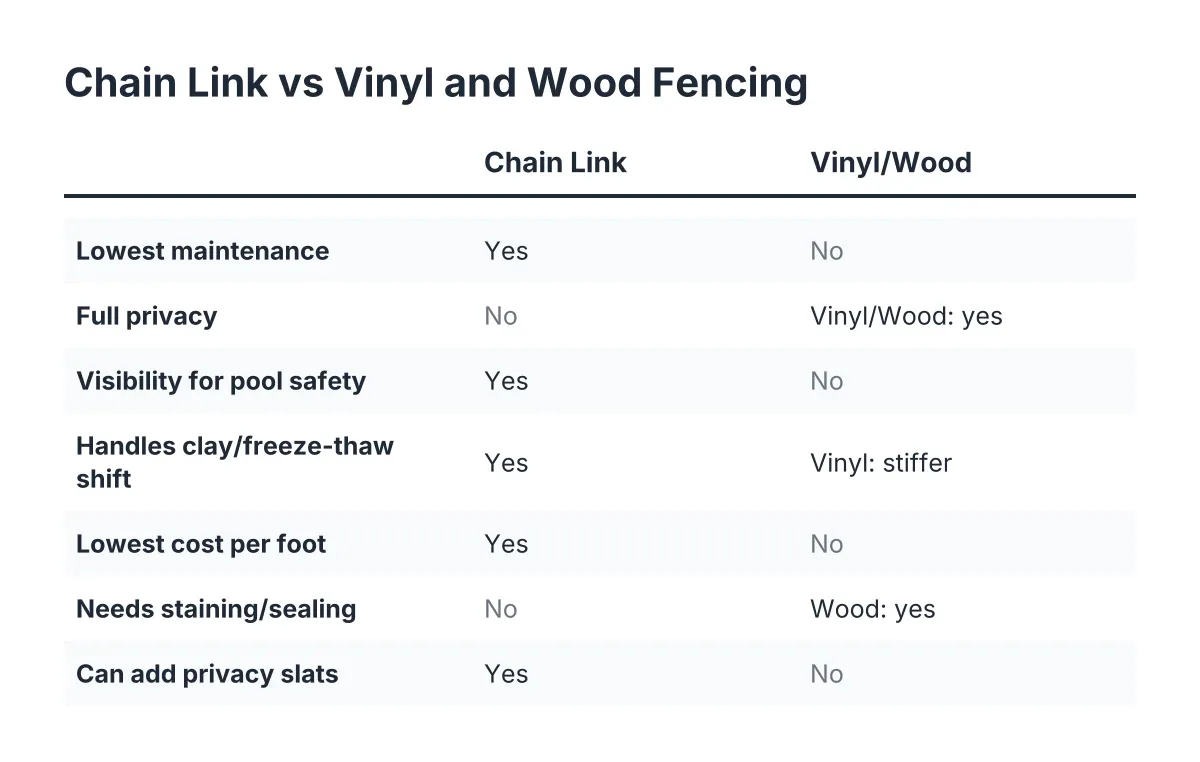
For pure security, chain link is hard to beat for the money. The steel mesh does not hide an intruder, you can see your whole yard through it, and the fabric is tied to a steel framework set in concrete. For pool safety, that visibility is a feature; you can see kids near the water from the house.
Vinyl privacy fence blocks the view entirely. That is good for privacy but it also means you cannot see what is happening on the other side. Wood sits in the middle; a solid privacy fence hides the yard, while a picket fence keeps sightlines open but offers less of a barrier.
One practical note for pool code: chain link mesh size and height both matter to inspectors, because the openings affect climbability. A good installer will spec fabric that meets the barrier requirements, not just whatever is on the truck. If your permit deadline is tight, ask the fence company directly whether their chain link spec has passed local pool inspections before.
Step 3: Weigh Maintenance, Including Chain Link Fence Vinyl Coating Options
Here is where the three materials split clearly. Galvanized chain link needs the least attention of anything on this list; it does not rot, insects ignore it, and there is nothing to paint. A vinyl-coated chain link fence, in black, brown, or green, adds a bonded layer over the steel that resists rust even longer and blends into landscaping better than bare silver.
Vinyl fence is also low maintenance. It resists rot and fading, and a rinse with a hose handles most dirt. It is still PVC, though, so it can crack from a hard mower strike in cold weather, and it will not survive direct fire the way steel does.
Wood asks the most of you. To get a full lifespan from a wood fence, plan on staining both sides, not just the street side. Staining both faces does more than improve the look; it meaningfully extends how long the boards last. Skip that, and Akron's wet springs and freeze-thaw winters will shorten the fence's life.
Quick maintenance comparison:
- Galvanized chain link: near zero; check ties and tension every few years
- Chain link with vinyl coating: near zero; the coating also protects against rust
- Vinyl fence: occasional washing; watch for impact cracks in winter
- Wood fence: stain or seal on a regular cycle, replace boards as they weather
Step 4: Compare Lifespan in Akron's Clay and Freeze-Thaw Ground
Lifespan here depends as much on the posts as the material above ground. Akron's clay-heavy soil holds water and shifts as it freezes and thaws. A fence with shallow or poorly drained posts will lean long before the panels or fabric wear out, no matter what you paid.
Chain link handles ground movement well because the steel framework and flexible fabric tolerate minor shifts without cracking. Vinyl is stiffer; the posts are the foundation of the whole system, and heavy-duty end and corner posts are built thicker than line posts for a reason. In tricky spots, such as butting against an existing fence, a metal pipe can be sleeved inside a vinyl post for extra strength. Wood lasts well when the posts are set deep and the boards are maintained, but untreated or unsealed wood gives up years to our wet seasons.
As a general ranking for this climate, steel chain link and well-set vinyl tend to outlast wood, with coated chain link at the durable end. The honest trade-off: chain link gives you the longest, lowest-effort service life, but it will never give you privacy on its own.
Step 5: Put Realistic Numbers Next to Each Option
Use national figures as a sanity check, not a quote. According to Redfin, fence installation costs average around $3,200 in the U.S., varying by material and fence type. HomeAdvisor data shows homeowners typically spend between $1,743 and $4,431 on a new fence, averaging $3,059 nationally.
Within that range, chain link usually lands at the lower end per foot, wood in the middle, and vinyl privacy fence toward the top. Gates, corners, slopes, old fence removal, and total footage move the number more than most homeowners expect. A vinyl-coated chain link fence costs more per foot than bare galvanized, but less than a full vinyl privacy fence.
One warning for comparison shoppers: the cheapest bid is often the most expensive fence. A cut-rate install with shallow posts in Akron clay can need rebuilding years early, which costs more in total than paying for proper post setting the first time. When you compare quotes, compare post depth, concrete, and material gauge, not just the bottom line.
Step 6: Decide Between DIY and Professional Chain Link Fence Installation
A handy homeowner can manage a short, flat run of chain link. Stretching the fabric evenly, setting posts plumb in wet clay, and choosing the right fence ties for each pipe diameter is where DIY installs usually go sideways. Fabric tied loose or stretched unevenly sags within a season.
Call a professional when any of these apply:
- The fence must pass a pool or permit inspection in 2026, where gate hardware and height are checked against code
- Your yard slopes or holds water in spring
- You are unsure where the property line sits, especially on older platted city lots
- The run includes multiple gates or corners
Professional chain link fence installation typically includes layout, post setting in concrete, framework assembly, fabric stretching and tying, and gate hanging. Old fence removal, haul-away, and privacy additions like chain link fence vinyl slats are often line items, so confirm what the fence quote covers. Most residential chain link jobs take a few days once posts are set, since concrete needs time to cure before the fabric is stretched; weather and ground conditions can stretch that. For property line questions or disputed boundaries, a survey is worth the cost before any posts go in; no fence company can settle a boundary disagreement for you.
Step 7: Add Privacy to Chain Link with Vinyl Slats if You Need Both
Suppose you want chain link's price and durability but your deck faces the neighbor's driveway. Chain link fence vinyl privacy slats, sometimes sold as inserts or strips, weave vertically through the mesh and block most of the view. They cost less than replacing the run with a vinyl privacy fence, and you can add them after the fence is up.
The trade-offs are real. Slats catch wind, so the posts must be set for that extra load, and they never match the full privacy of solid panels. For total privacy on a long back line, a vinyl or wood privacy fence is still the better tool. For a pool enclosure that needs code compliance now and some screening later, chain link with slats is a practical middle path.
Step 8: Pick a Fence Company with the Right Questions
Finish by qualifying the installer, not just the price. Ask these three questions on every estimate call:
- How deep do you set posts in clay soil, and how do you handle drainage around them?
- What exactly does the quote include: removal, gates, hardware, concrete, and cleanup?
- Have your chain link and gate specs passed local pool barrier inspections?
A fair fence quote lists footage, material gauge or thickness, post spacing, gate count, and what happens to the old fence. Vague one-line bids are where surprise charges hide.
If you are comparing materials for a yard in Akron or the surrounding Northeast Ohio area, Akron Fence Co installs chain link, vinyl, wood, aluminum, and ornamental fencing and will give you a clear estimate based on your actual property line and ground conditions. Reach out to schedule a fence estimate and get a straight answer on which material fits your yard and your deadline.
If you need chain link fence installation, Akron Fence Co can help.
Prefer to talk it through? Call (330) 302-2470 — a quick call is usually the fastest way to get a straight answer for your situation.