
Chain Link Fence on Uneven Ground: Grading, Drainage, and Stability Steps
A chain link fence on uneven ground is a different job than one on a flat lot. The specific challenges of a chain link fence sloped across uneven terrain are significant: Akron yards rarely sit level. New-build lots get graded for drainage, which means your backyard probably slopes away from the house, and older platted lots have dips, swales, and settled spots. If you handle a sloped chain link fence on uneven terrain the wrong way, you end up with gaps under the fabric, posts that heave in winter, or a top rail that wanders up and down the line. Here is the step-by-step process a competent crew follows, so you know what to expect and what to ask about when you compare quotes.
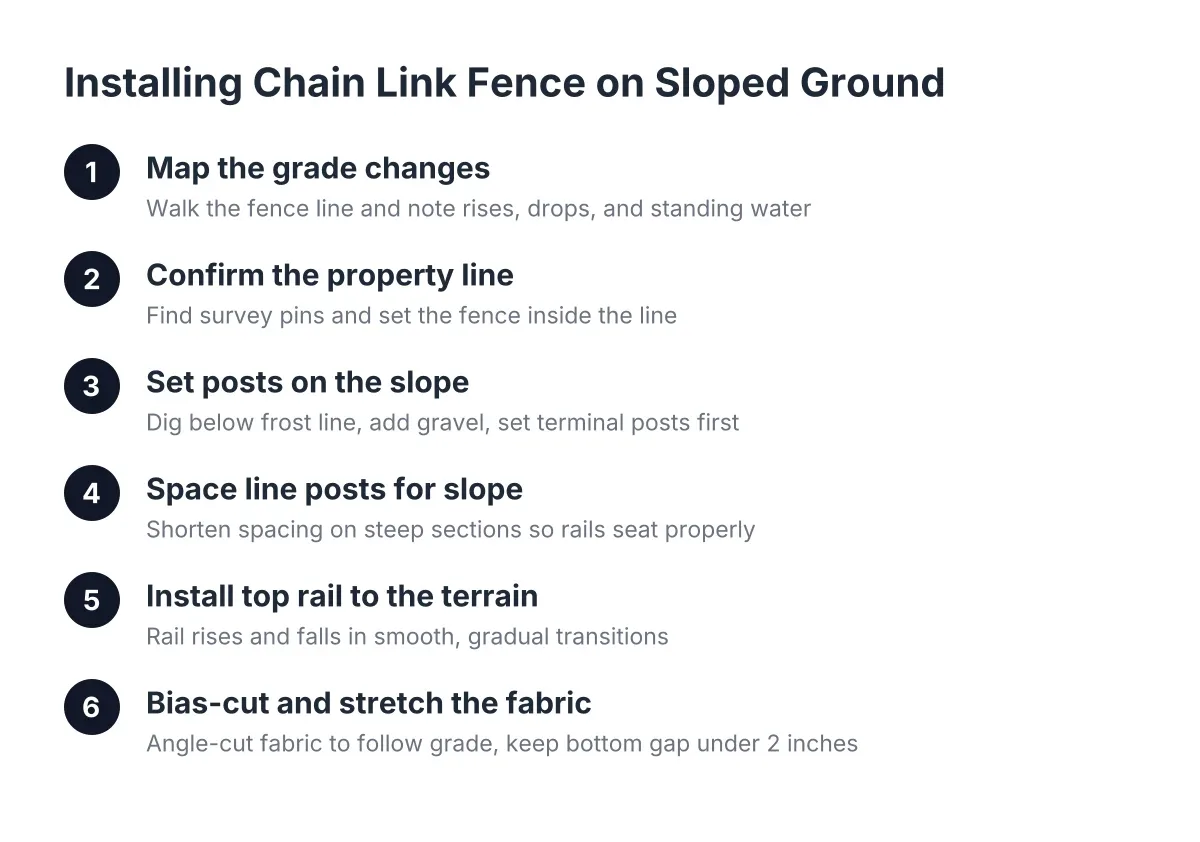
Step 1: Walk the Fence Line and Map the Grade Changes
Before anyone digs, walk the full fence line and note every change in grade. Mark where the ground rises, where it drops, and where water sits after a rain. Clay-heavy soil around Akron holds water, and standing water along a fence line is a warning sign for post problems later.
Decide at this stage how the fence will handle each slope. There are two basic approaches:
- Follow the grade. The fence runs parallel to the ground, rising and falling with it. The bottom of the fabric stays close to the dirt the whole way. This is the standard method for most residential chain link.
- Step the fence. Each section stays level, and the fence drops in steps where the ground falls. Steps leave triangular gaps under the fabric on slopes, which matters if you have a small dog.
For most Akron yards with gradual grade changes, following the grade works best. Save stepping for retaining walls or sharp drops. If your lot has a slope steep enough that you cannot walk it comfortably, that is a sign to bring in a professional rather than fight it yourself.
Step 2: Confirm the Property Line Before You Set Anything
Grade problems and property line problems compound each other. On a sloped lot, it is easy to drift off the line while you focus on the terrain. Find your survey pins or hire a surveyor to mark them, especially on a new-build lot where the pins may still be findable near the corners.
Set the fence a few inches inside the line so the concrete footings and the fabric stay on your side. Check Akron setback rules for your parcel too; older city lots and newer suburban parcels often follow different norms.
Step 3: Setting Posts on Sloped Chain Link Fence Ground
Set the terminal posts first: corners, ends, and gate posts. These posts take the tension when the fabric gets stretched, so they get the largest footings. Dig below the frost line; Akron's freeze-thaw cycles will push a shallow post out of the ground within a few winters, and clay soil makes that worse.
Drop a few inches of gravel in the bottom of each hole before the post goes in. The gravel gives water somewhere to go and gives the post a stable base. This matters more on uneven ground, where low spots collect runoff. One common misconception is that dumping extra concrete in the hole fixes stability. It does not. Depth, gravel drainage, and proper backfill do more for a post than an oversized blob of concrete.
Once the terminal posts cure, stretch a string line between them. The string keeps the fence line straight even when the ground refuses to cooperate. On a slope, run a second string across the post tops to keep a consistent height above grade, the same way crews do along a pitched driveway.
Step 4: Space Line Posts for the Slope, Not the Flat-Ground Chart
Generic chain link fence installation diagrams assume flat ground and give you one post spacing, usually ten feet. On a slope, that spacing can fail you. Rails run point to point between posts, so on a steep grade the diagonal distance between posts grows longer than the ground distance. A full-length rail may not reach into its fitting.
Therefore, shorten the post spacing on steep sections so the rails seat properly. On a sloped run, you may also need to backfill one side of a post hole higher than the other so the post stands plumb while the top rail follows the grade smoothly. When installing a chain link fence on sloped terrain, check each post with a level on two faces, not just one. A post that leans downhill will telegraph through the whole run once the fabric goes on.
Step 5: Install the Top Rail to Follow the Terrain
With line posts set and cured, slide the loop caps on and run the top rail. On a chain link fence over uneven ground, the top rail should rise and fall in smooth, gradual transitions, not sharp kinks. Where the grade changes direction, a rail can flex slightly through the loop caps; sharper breaks need the rail cut and joined at a post.
Step back and sight down the rail from one end. Your eye catches a wavy rail faster than any level does. Fix humps and dips now, because the fabric will lock them in later.
Step 6: Make the Bias Cut and Stretch the Fabric on Uneven Ground
This step separates a clean job from a saggy one. Chain link fabric is woven on the square, so on a slope it wants to hang with gaps at the bottom or bunching at the top. The fix is a bias cut: the fabric gets cut and re-hung at an angle so the mesh follows the grade while the top edge tracks the rail.
Stretching chain link fence on uneven ground takes patience. Attach the fabric at one terminal post with a tension bar, then pull it taut with a fence stretcher toward the other end. On a slope, stretch in shorter runs and check the bottom gap as you go. The goal is an even gap, about two inches or less, along the whole line.
When tying the fabric to the posts and rail, stand on the side opposite the mesh where access allows; it makes the ties easier to twist tight. Note that fence ties come in different lengths matched to the pipe diameter, so buy ties sized for your actual posts, not a generic bag.
Step 7: Hang the Gate Where the Ground Is Most Level
Place gates on the flattest stretch of the fence line you can manage. A gate on a slope either drags the ground when it swings uphill or leaves a large gap when the ground falls away. If the only workable spot slopes, hang the gate to swing toward the downhill side.
Measure the chain link fence gate rough opening between the gate posts carefully; the gate frame plus hinge and latch hardware must fit that opening with clearance to swing. On uneven ground, measure the opening at the top and the bottom, because out-of-plumb posts make those two numbers disagree.
Step 8: Address Drainage and Gaps Along the Bottom
After the fabric is tied off, walk the line one more time and deal with the low spots. Options include:
- Adding topsoil to fill minor dips, then seeding over it
- Running tension wire along the bottom to stiffen the fabric edge over small gaps
- Placing a grade board or gravel in a swale where water needs to keep flowing
Do not block a drainage swale with fill. On new-build lots especially, that swale was graded on purpose, and damming it sends water toward your foundation or your neighbor's yard. If old concrete footings from a previous fence sit along the line, consider leaving them; buried footings can stabilize the surrounding soil rather than hurt the new fence.
What a Chain Link Fence on Sloped Ground Should Cost You
Sloped ground adds labor, and your quotes should reflect that honestly. For context, HomeAdvisor data shows homeowners typically spend between $1,743 and $4,431 on a new fence installation, averaging $3,059 nationally, and Redfin reports fence installation averages around $3,200 in the U.S. Chain link usually lands at the lower end among fence materials, but grade work, extra posts on steep runs, and bias cuts add time.
Suppose a homeowner on a new-build lot in Akron needs about 150 feet of perimeter fence, and the back corner drops across a drainage swale. In that scenario, a fair 2026 fence estimate would itemize the extra line posts for the slope, the bias-cut labor, and how the crew will handle the swale. If a bid for a chain link fence on uneven ground reads exactly like a flat-lot bid, ask what the crew plans to do at the grade changes. The answer tells you more than the price does.
When you search for chain link fence installation near me and start comparing bids, bring the questions from this guide to each call: follow the grade or step it, how deep do posts go in clay, and what happens at the swale. Any fence company worth hiring in 2026 can answer all three without hesitation.
If you need chain link fence installation, Akron Fence Co can help.
Prefer to talk it through? Call (330) 302-2470 — a quick call is usually the fastest way to get a straight answer for your situation.