
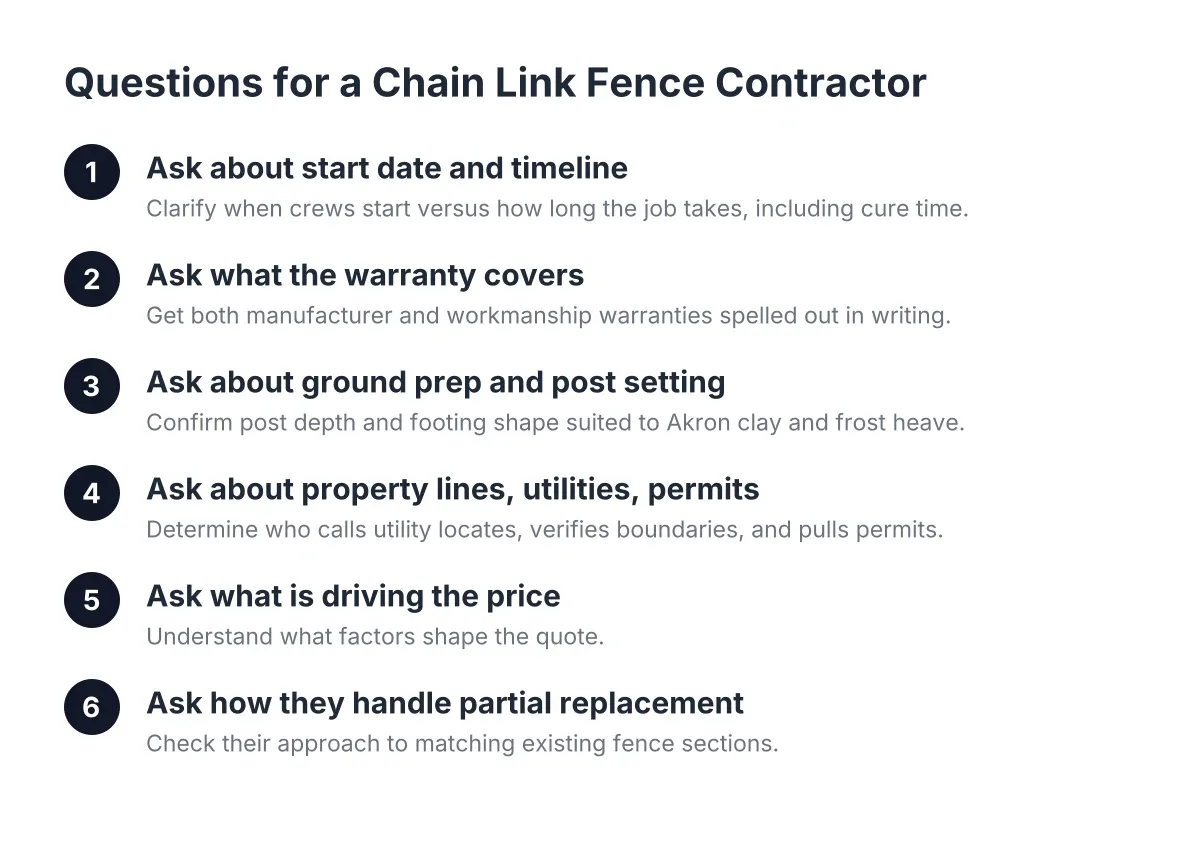
What to Ask a Chain Link Fence Installation Contractor Before You Hire
A storm knocks a limb through your fence, the dog yard is wide open, and now you need chain link fence installation done right, and soon. Before you hire anyone, a short list of direct questions will tell you more than any online guide or installation diagram. The answers show whether a contractor knows Akron ground, stands behind the work, and can give you a real timeline instead of a vague promise. Here is how to work through those questions, step by step.
Step 1: Ask How Soon They Can Start and How Long the Job Takes
Start with timeline, because for most homeowners in this spot, timeline is the whole reason you are calling. A storm-damaged fence is a security problem, not just a cosmetic one.
Ask two separate questions. First, when can a crew actually start? Second, how many days will the work take once it starts? Those are different answers, and a contractor who blurs them together is dodging.
For a typical residential chain link job, the on-site work often breaks into two visits. Posts get set in concrete on day one, then the crew returns after the concrete cures to hang the framework and stretch the fabric. Ask whether the quote includes that cure time, because it can add days between visits.
In addition, ask what could push the date. Material availability matters here. Standard galvanized chain link is usually stocked locally. A brown chain link fence, or any color-coated fabric, may need to be ordered, which can stretch the schedule by a week or more. If you want brown or black vinyl-coated mesh to blend into a tree line, ask about lead time before you commit.
Step 2: Ask What the Warranty Actually Covers
A fence has two warranties, and you want both spelled out. There is a manufacturer warranty on the materials, meaning the fabric, posts, rails, and fittings. Then there is the installer's workmanship warranty, which covers how the fence was built.
The workmanship side is the one that matters most in Northeast Ohio. Akron's clay-heavy soil shifts with freeze-thaw cycles, and a post that was set too shallow or in a sloppy footing will lean within a few winters. Ask these questions directly:
- How long is your workmanship warranty, and is it in writing?
- If a post heaves or leans in the first few years, who fixes it and who pays?
- Does the warranty cover gates sagging or latches going out of alignment?
- What voids the warranty? For example, a vehicle hitting the fence or a tree falling on it.
However, be realistic about what no warranty covers. Storm damage, fallen limbs, and impact damage are usually excluded, which is why some homeowners check with their insurance carrier on storm claims before signing anything. A fair contractor will say plainly what is covered and what is not, rather than waving the question off.
Step 3: Ground Preparation and Post Setting for Chain Link Fence Installation
This is where generic chain link fence installation instructions and the real job part ways. A downloadable installation guide PDF shows a diagram of a post in a concrete footing. It does not show what happens to that footing in Akron clay after three winters.
Ask the contractor how deep they set posts and why. In clay soil that holds water and heaves with frost, post depth and footing shape decide whether the fence stays straight. A post set below the frost line, with concrete bellied at the bottom, resists heave. A shallow post in a straight-sided hole can get pushed up a little each winter until the fence line looks like a wave.
Next, ask how they handle layout. A careful crew sets the end and corner posts first, then stretches a string line between them so every line post lands straight. On a sloped driveway or a graded side yard, they run a second string across the post tops so the fence follows the ground at a consistent height. If the person quoting your job cannot describe that process in plain words, that tells you something.
Also ask what happens to the old fence and the old footings. Pulling a rotted wood post and its concrete plug takes real labor, and quotes vary on whether removal and haul-away are included. Get it in writing either way.
What the Diagrams Leave Out of Chain Link Fence Installation
Online diagrams cover the parts: terminal posts, line posts, top rail, tension bands, tension bars, and tie wires. What they skip is judgment. For instance, fence ties come in different lengths matched to the pipe diameter, and using the wrong ones leaves loose fabric that rattles in wind. Stretching the fabric to proper tension without distorting the diamonds takes a fence puller and a feel for the material.
Grading judgment matters too. Where a yard dips, an installer decides whether to follow the contour or bridge the low spot and fill the gap, which matters if the fence is holding a dog. A diagram cannot make that call for your yard. A good contractor walks the line with you and explains the choice before digging.
Step 4: Ask About Property Lines, Utilities, and Permits
Before any post hole gets dug, someone has to confirm where the fence can legally go. Ask the contractor three things: who calls for utility locates, who verifies the property line, and who pulls the permit if the city requires one.
Utility locates are standard practice and the contractor should handle that call. The property line is usually on you as the homeowner. On Akron's older platted city lots, the existing fence is not proof of the boundary; fences drift over decades of replacements. If your survey pins are missing and your neighbor disputes the line, resolve that before installation, not after. A fence set on the wrong side of a property line is an expensive mistake to move.
Therefore, ask what documentation the contractor wants from you before digging. A contractor who asks about pins, plats, or setbacks is protecting you. One who says "we'll just follow the old fence" is passing the risk to you.
Step 5: Ask What Is Driving the Price in Your Quote
You do not need to memorize a cost estimator; you need to understand your own quote. For national context, according to HomeAdvisor, homeowners typically spend between $1,743 and $4,431 on a new fence installation, averaging $3,059 nationally. Chain link usually sits toward the lower end among fence materials, which is part of its appeal for yards and dog runs.
Ask the contractor to break the quote into parts so you can compare bids fairly:
- Fabric height and gauge, since taller fence and thicker wire cost more
- Galvanized versus color-coated, because a brown chain link fence runs higher than plain galvanized
- Number of gates, gate hardware, and gate width
- Post depth, footing size, and concrete, the part that fights Akron frost heave
- Tear-out and haul-away of the old fence
- Corners and terminal posts, since more direction changes mean more heavy posts
A cheap bid often cuts the invisible items: shallower posts, thinner-wall pipe, fewer ties. The fence looks identical on day one. The difference shows up in year five. Paying less for a fence that needs rebuilding sooner costs more over time than a solid job did upfront.
Step 6: Ask How They Handle Partial Replacement and Matching
Suppose a homeowner in Goodyear Heights has a wind-thrown maple limb flatten 30 feet of a 15-year-old galvanized chain link run, while the rest of the fence stands fine. The right question is not "what does a whole new fence cost," it is "can you replace this section and tie into what is standing?"
Ask whether the contractor takes partial jobs at all; some only quote full replacements. Then ask how they match the existing fence. Matching means same fabric height, similar wire gauge, and the same finish. New galvanized next to weathered galvanized will look brighter for a while, and an honest installer says so upfront.
A fence repair call should not turn into a pressure pitch for replacing the whole yard. That said, if the standing posts are badly heaved or the rails are rusted through, a full replacement can genuinely be the cheaper path over the next ten years. Ask the contractor to explain the condition of what remains, in specifics, so the repair-versus-replace decision is yours and based on evidence.
A Short Checklist to Bring to Every Fence Estimate
Chain link fence installation is one of the more forgiving fence projects, but the questions you ask before signing decide how it ages. Bring this list to each estimate:
- Start date and working days, with concrete cure time included
- Written workmanship warranty, with heave and lean covered
- Post depth, footing shape, and how they handle clay soil
- Who confirms the property line and calls utility locates
- Line-item quote: fabric, coating, gates, concrete, tear-out
- Whether they will repair or match a section instead of replacing everything
Compare the answers, not just the bottom-line numbers. The contractor who explains ground prep in plain language, puts the warranty in writing, and gives you an honest timeline is the one whose fence will still be standing straight after a few Akron winters.
If you need chain link fence installation, Akron Fence Co can help.
Prefer to talk it through? Call (330) 302-2470 — a quick call is usually the fastest way to get a straight answer for your situation.