
Vinyl vs. Wood Fence in Akron: Which One Survives Our Freeze-Thaw Winters?
If you just closed on a new home in Akron with a bare yard, you are probably comparing fence quotes right now. The vinyl vs. wood question comes up on almost every estimate, and the honest answer depends on how each material handles Akron's clay soil and freeze-thaw winters. Vinyl fence installation costs more up front than wood in most cases, but the two materials age in different ways here. This guide walks you through the comparison step by step, the same way you would work it if you were sitting at the kitchen table with three fence quotes in front of you.
The goal is simple. By the end, you should be able to tell a fair fence estimate from a padded one, and know which material actually fits your yard, your budget, and your tolerance for weekend maintenance.
Step 1: Start With What Akron Weather Does to Each Material
Before you compare prices, compare failure modes. Wood and vinyl fail differently, and Akron's climate decides how fast.
Wood fences in Northeast Ohio fight moisture year-round. Rain soaks the boards, winter freezes the moisture inside the grain, and the cycle repeats dozens of times a season. The panels you can see are usually not the first thing to go. The posts are. Wood posts sit in wet clay soil, and rot works from the ground line down, even when a homeowner has faithfully repainted the panels for years.
Vinyl handles moisture differently because it cannot rot. It will not absorb water, so freeze-thaw cycles do not split it from the inside the way they split wood grain. It also will not fade the way a stained wood fence grays out after a few seasons. Vinyl is still PVC, so it is not fireproof and it can crack under a hard direct impact in extreme cold, but for everyday Akron weather it holds its shape and color with almost no upkeep.
Here is the short version:
- Wood: warm look, lower upfront cost, needs staining or sealing on a regular schedule, posts are the weak point in wet clay
- Vinyl: higher upfront cost, no staining or painting, resists rot and fading, posts act as the backbone of the whole system
- Both: depend completely on how well the posts are set in Akron's shifting soil
Step 2: Understand Why Posts Decide the Whole Comparison
The posts are the foundation of any fence, wood or vinyl. Akron's clay-heavy soil expands and contracts with every freeze-thaw cycle, and that movement is what heaves posts out of plumb over time. A fence with perfect panels and bad posts is a bad fence.
For wood, this is a double problem. The soil moves the post, and the moisture in the soil rots it. Staining both sides of a wood fence extends its life a great deal, but no stain protects the buried portion of a post sitting in wet clay.
Vinyl posts work on a different principle. A hollow vinyl post sleeves over or anchors to a concrete footing, and because the vinyl itself cannot rot, the footing depth and quality become the whole ballgame. In tight spots, say where a new fence butts against a neighbor's existing fence or wraps around a mature tree, installers can even run a metal pipe inside the vinyl post for reinforcement. Heavy-duty end and corner posts are made thicker than standard line posts for the same reason: those points carry the most load.
Therefore, when you compare fence quotes, ask every fence company one question first. How deep do you set posts, and how do you handle clay soil? The answer tells you more than the price does.
Step 3: Compare the Maintenance Years, Not Just Year One
A fence quote shows you the cost of year one. The material decides the cost of years two through twenty.
Suppose a homeowner on a new-build lot in Akron installs 180 feet of wood privacy fence. In that scenario, keeping it looking good means staining or sealing it every few years, on both sides if they want the full lifespan out of it. That is either a long weekend of labor each cycle or a recurring bill to hire it out. Skip the maintenance and the fence grays, warps, and loses years of life.
Now run the same hypothetical yard in vinyl. The maintenance plan is a garden hose and occasionally a bucket of soapy water. There is no staining schedule, no repainting, and no annual inspection for soft spots at the ground line. Over a 15-to-20-year window, the maintenance gap closes much of the upfront price difference between the two materials.
However, be honest about the trade-offs. Vinyl cannot be refinished if you change your mind about color. A cracked vinyl panel gets replaced, not patched and repainted. And some homeowners simply prefer the look of real wood, which is a fair reason to accept the maintenance schedule.
Step 4: Proper Installation Techniques for Vinyl Fencing
Knowing the basic sequence helps you judge any installer you interview, and helps you decide whether a DIY attempt is realistic for your yard.
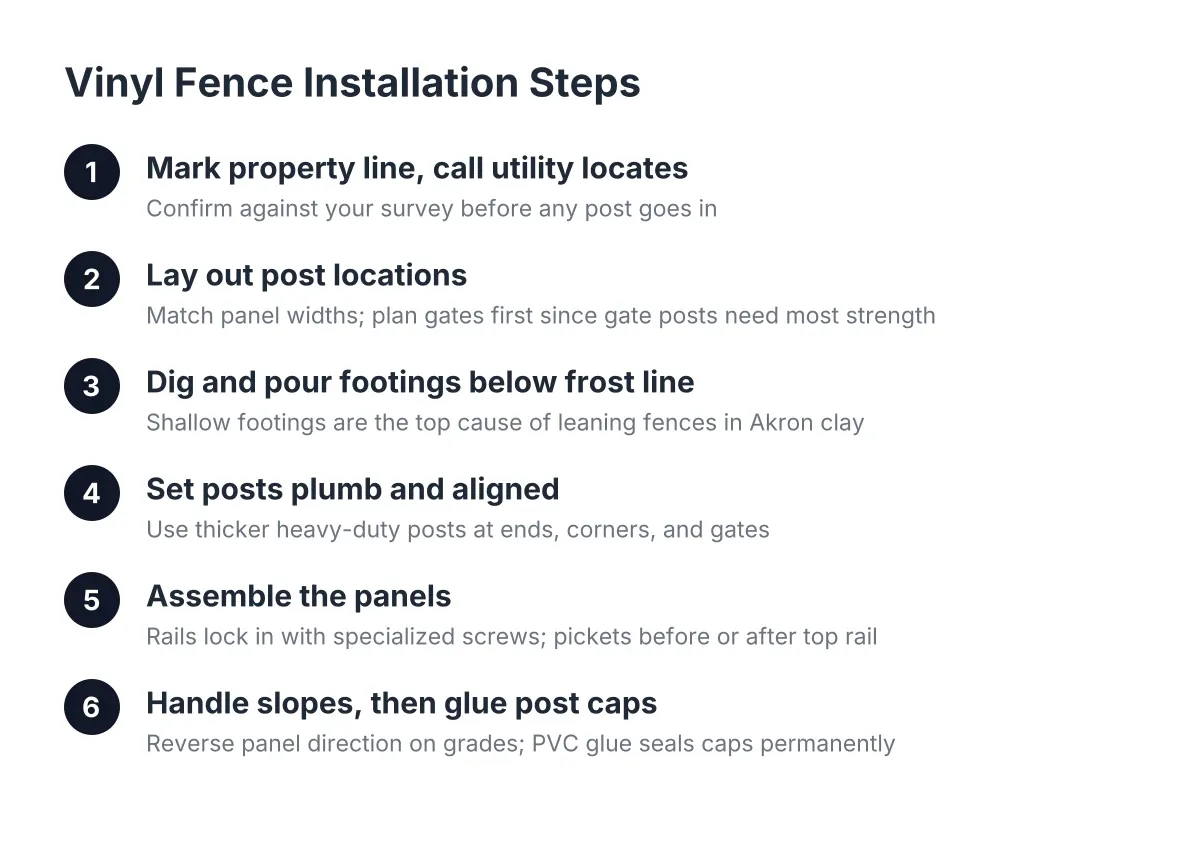
A sound vinyl fence installation follows this order:
- Mark the property line and call for utility locates. On new-build lots, do not trust the builder's stakes alone; confirm against your survey before any post goes in.
- Lay out post locations to match the panel widths, with gates planned first since gate posts need the most strength.
- Dig and pour footings below the frost line. In Akron's clay, shallow footings are the number one cause of leaning fences a few winters later.
- Set posts plumb and aligned, with thicker heavy-duty posts at ends, corners, and gates.
- Assemble the panels. Rails cut to length fit snugly between posts and lock in with specialized screws. Pickets can go in before or after the top rail; both methods work.
- Handle slopes deliberately. On a graded section, installers can reverse the direction they build a panel so pickets do not slide downhill as they are inserted. This is the kind of detail a video tutorial rarely shows.
- Glue the post caps. PVC glue inside each cap seals it permanently so caps do not pop off in a winter windstorm.
- Hang and adjust the gate last, checking swing and latch alignment after everything else is locked in.
If you are searching vinyl fence installation guides and planning a DIY run, the digging and footing work is where most projects go wrong, not the panel assembly. Special cases raise the difficulty further. Learning how to install vinyl fence on concrete, for example, means core-drilling or using surface-mount brackets with anchor bolts, and a gate that sags because its post flexes is the most common DIY regret. For a full perimeter on a new lot, or any run with slopes, concrete, or tight property-line questions, a professional crew earns its labor cost.
Step 5: Put Real Numbers Next to Each Bid
You wanted pricing context before the first phone call, so here is the honest version. National figures give you a floor for sanity-checking, not a quote for your yard.
According to HomeAdvisor, homeowners typically spend between $1,743 and $4,431 on a new fence installation, averaging $3,059 nationally. Redfin reports a similar national average of about $3,200, varying by material and fence type. A full vinyl perimeter on a larger suburban lot will usually land above those averages because vinyl's material cost per foot runs higher than wood's, while wood shifts more of its lifetime cost into maintenance.
What moves your specific number in 2026: total linear footage, number of gates, slope and grade changes, soil and digging conditions, old fence removal, and fence height and style. A clear estimate should break those out so you can compare bids line by line instead of guessing why two quotes for the same yard differ.
Step 6: Make the Call Based on Your Yard, Not the Internet's
Pull it together with three questions. How long do you plan to stay in the house? How much maintenance will you honestly do? And what does your specific lot demand?
For a new-build perimeter owner planning to stay ten-plus years, vinyl usually wins the long game in Akron. It shrugs off the freeze-thaw moisture cycle that kills wood posts, and it asks nothing of your weekends. For a tighter budget or a shorter ownership horizon, wood delivers privacy for less money up front, as long as you commit to the staining schedule.
Whichever way you lean, judge every fence company by how they talk about posts, frost depth, and your property line. Vinyl fence installation done right in Akron clay outlasts the fence next door that was done fast. That difference never shows up on the day the crew leaves; it shows up four winters later.
Prefer to talk it through? Call (330) 302-2470 — a quick call is usually the fastest way to get a straight answer for your situation.