
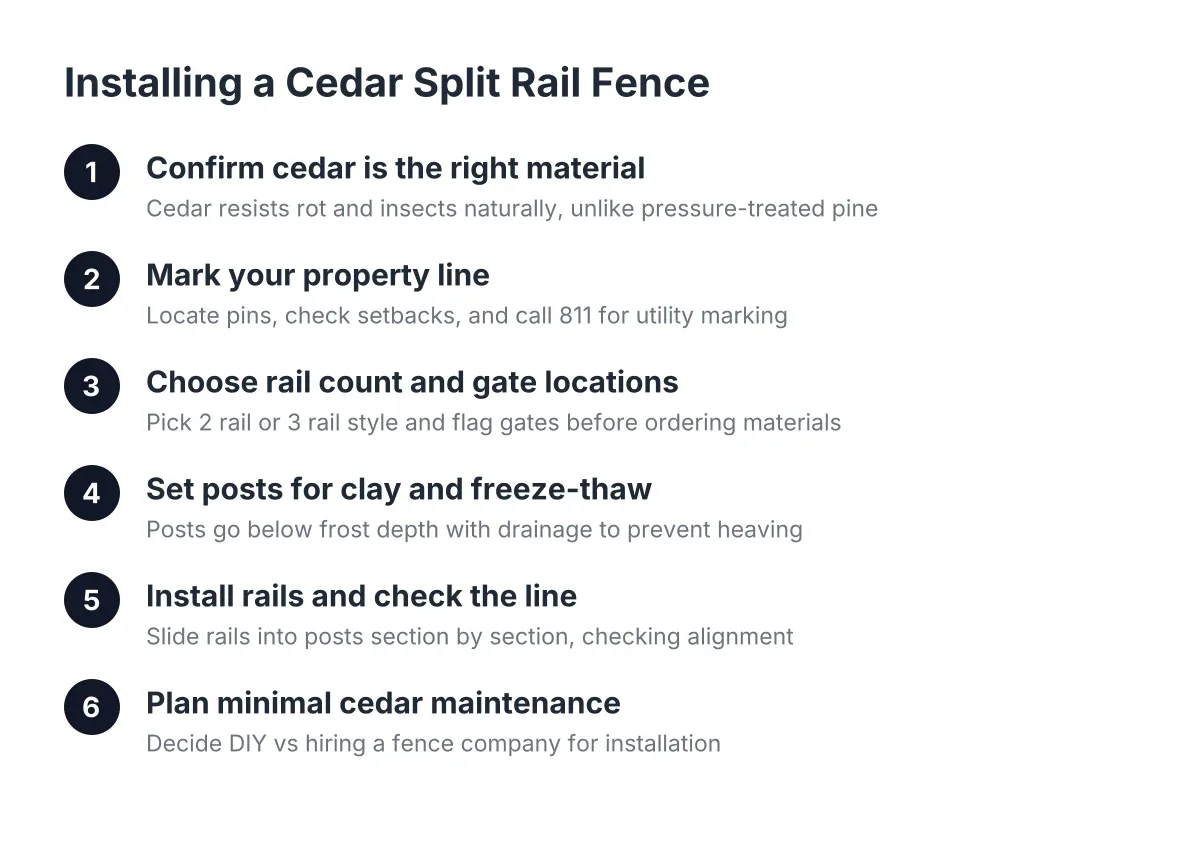
Cedar Split Rail Fence in Ohio: Durability, Maintenance, and Weather Performance
A cedar split rail fence holds up to Ohio weather better than most wood fencing, and it does it without much upkeep. Cedar resists rot on its own, so the rails and posts handle Akron's wet springs and freeze-thaw winters without paint or sealant. The split rail fence lifespan in this climate is measured in decades when posts are set properly. If you just closed on a new build with an unfenced lot, or a storm took out a section of rail fence and you need it back fast, this guide walks you through getting a cedar split rail fence installed right, step by step.
Step 1: Confirm Cedar Is the Right Split Rail Material
Cedar earns its place as the standard material for split rail fencing because it resists rot and insects naturally. Pressure-treated pine costs less up front, but it tends to warp and check as it dries, and the green tint takes years to fade. Cedar weathers to a silver-gray that most homeowners like, and it does so without twisting out of line.
Here is the honest trade-off: cedar costs more than treated pine, and if you ever decide to stain it, cedar can absorb stain unevenly. Most split rail owners skip stain entirely and let the wood gray out, which is the lowest-maintenance path.
For reference on budget, HomeAdvisor data shows homeowners typically spend between $1,743 and $4,431 on a new fence installation, averaging $3,059 nationally. Split rail usually lands on the lower end of wood fencing because it uses less lumber per foot than a privacy fence. Your actual number depends on footage, gates, terrain, and how many corners the line turns.
What Affects Split Rail Fence Lifespan in Ohio?
A cedar split rail fence in Northeast Ohio commonly lasts decades, with posts failing before rails do. Rot at the ground line is what ends most wood fences, even ones with well-kept rails above grade. Cedar's natural rot resistance slows that process considerably compared to untreated pine. Understanding the split rail fence lifespan in your climate means paying close attention to post depth and soil drainage, the two factors that matter most.
The weak point is always where the post meets wet soil. Akron's clay-heavy ground holds water against posts, and freeze-thaw cycles work on anything set shallow. That is why post depth and drainage matter more than any product you could brush on later. Get Step 4 right and the fence outlives most of what else is in the yard.
Step 2: Mark Your Property Line Before Anything Else
Find your property pins before you set a single post. On a new build, the survey from closing usually shows pin locations at the corners of the lot. On older platted Akron city lots, pins may be buried or missing, and neighbors' assumptions about the line are often wrong by a foot or more.
Setting a fence over the line creates a problem that costs far more to fix than a survey costs to prevent. If you cannot locate your pins, hire a surveyor before the fence crew arrives. In addition, check your city or township setback rules; some areas require the fence to sit inside the line by a set distance.
Call 811 for utility marking as well. Split rail posts go two feet or deeper, and gas and cable lines in newer subdivisions often run shallower than people expect.
Step 3: Choose Your Rail Count, Spacing, and Gate Locations
A 2 rail split rail fence runs about three feet tall and works well for marking a boundary on a new lot. A 3 rail fence stands closer to four feet and does a better job slowing down kids and larger dogs. Neither style contains a small dog on its own; plan for welded wire mesh on the inside face if pet containment is the goal.
Decide this before ordering materials, because posts are drilled for a specific rail count:
- 2 rail: boundary definition, decorative frontage, open sightlines
- 3 rail: pet yards with mesh backing, pasture-style looks, slightly more presence at the street
- Mesh add-on: attaches to the yard side, nearly invisible from the road, standard for dog owners
- Gates: place one wide enough for a mower at minimum; a drive-through gate needs heavier posts set deeper
Walk the line and flag every gate location now. Moving a gate after posts are set means pulling and resetting posts, which is wasted money.
Step 4: Set Posts for Akron's Clay and Freeze-Thaw Cycles
Post setting decides whether the fence stands straight in ten years. Akron's clay soils swell when wet and heave when frozen, and a shallow post will lean or lift within a few seasons. Posts need to go below frost depth, with attention to drainage at the bottom of each hole so water does not pool around the post base.
Cedar split rail fence posts come pre-drilled with two or three holes, and the rails slide in with no fasteners. That is one reason this style handles ground movement better than panel fencing; the joints flex instead of cracking. However, that flexibility only works if the posts themselves stay put.
For example, suppose a homeowner on a new-build lot in Green sets line posts 18 inches deep to save on digging. The first winter, three posts heave an inch or two, the rails rack out of level, and by spring the fence reads as crooked from the street. A typical crew fixing that job pulls every shallow post and resets it below frost line, which costs more than doing it right once.
Gate posts and corner posts take the most load. Set them deeper and consider concrete at those locations even if line posts are set in packed gravel and soil.
Step 5: Install Rails and Check the Line As You Go
Slide rails into the post holes section by section, working from one end or a corner. Check the line by eye down the full run every few sections; split rail forgives gentle grade changes, but a kinked line stands out. On slopes, the fence steps or follows the grade, and cedar rails handle either approach.
If you are adding welded wire mesh for pets, staple it to the yard side after all rails are in. Pull it taut between posts and keep the bottom edge at or just below grade so a dog cannot push under it.
This is the step where many homeowners decide to call a fence company instead of finishing a DIY run. Digging thirty post holes in Akron clay by hand is brutal work, and an auger hitting a root or old footing mid-line can stall the whole project. If the line crosses a slope, turns multiple corners, or includes a drive gate, professional fence installation is usually worth the labor cost.
Step 6: Plan the Minimal Maintenance Cedar Actually Needs
A cedar split rail fence asks for less than any other wood fence, but it is not zero. Build these habits into your yard routine:
- Walk the line each spring and fall. Push on posts near corners and gates; any movement means soil or drainage trouble worth catching early.
- Keep soil, mulch, and leaf piles off the post bases. Buried wood stays wet, and wet wood rots, even cedar.
- Trim vegetation back from the rails so air can dry the wood after rain.
- After any storm, check for cracked rails or limbs resting on the fence. A rail is a slide-in part; one broken rail is a cheap, fast swap, not a rebuild.
That last point matters if you are reading this because a storm just dropped a branch across your fence. Split rail is the easiest fence style to repair in sections. Rails pull out and replace in minutes, and a single snapped post can be dug out and reset without touching the rest of the line. A fence repair call for storm damage on a split rail fence should be a small job, and any fair estimate will reflect that.
Step 7: Decide Between DIY and Hiring a Fence Company
Handle it yourself if the run is short, flat, and simple, and you have access to an auger. A 60-foot boundary run with no gates is a reasonable weekend project for two people. Materials for cedar split rail are sold by the section, so ordering is straightforward once you measure the line.
Call a local fence company when any of these apply:
- The line exceeds roughly 100 feet or turns several corners
- You need gates, especially a drive gate
- The property line is uncertain or disputed
- The ground is sloped, rocky, or full of roots
- Storm damage took out posts, not just rails, and the dog is getting out now
When you request a fence estimate, ask three things: how deep they set posts for this soil, whether they locate the property line or require a survey, and whether they handle section repairs as well as full installation. A clear estimate lists footage, post count, rail count, gates, and mesh separately, so you can see exactly what you are paying for. Vague lump-sum numbers make comparison impossible.
Timeline-wise, a straightforward residential split rail job is typically measured in days, not weeks, once materials are on hand, though scheduling in Northeast Ohio tightens up in spring and early summer when everyone wants a fence at once.
Get the Fence Line Right the First Time
Cedar split rail suits Akron properties for the same reasons it has lined Ohio farm roads for generations: it handles weather, shrugs off ground movement, and repairs in pieces instead of panels. Set the posts below frost, respect the property line, and the maintenance list stays short.
If you are staring at an unfenced new-build lot or a storm-wrecked section and would rather not dig clay by hand, Akron Fence Co installs and repairs split rail fencing across the Akron area. Reach out for a straightforward fence estimate; we will walk the line with you, confirm the layout, and give you a clear number before any work starts.
If you need split rail fence installation, Akron Fence Co can help.
Prefer to talk it through? Call (330) 302-2470 — a quick call is usually the fastest way to get a straight answer for your situation.