
2 Rail vs 3 Rail Split Rail Fence: Which Style Fits Your Akron Property
If you are weighing a 2 rail or 3 rail split rail fence, the choice comes down to one question: what is this fence actually for? A 2 rail fence marks a boundary. A 3 rail fence contains something, holds a slope, or supports wire mesh for pets. When deciding between a 2 rail vs 3 rail fence, homeowners across Akron pick the wrong one all the time, usually because nobody walked them through how the two styles behave differently on a real property line. This guide fixes that, step by step.
Split rail is popular here for a reason. It is honest fencing. It says "this is my yard" without putting up a wall, which matters when you are trying to settle a boundary question without starting a feud with the neighbor. Follow the steps below and you will know exactly which rail count fits your lot before you ever ask for a fence estimate.
Step 1: Decide What the Fence Has to Do
Start with the job, not the look. A split rail fence does one of three things: it marks a property line, it keeps pets or kids inside, or it meets a code requirement. Each job points toward a different rail count.
For a pure boundary marker, a 2 rail fence is usually enough. It sits around three feet tall, it is cheaper per foot because it uses less wood, and it reads as neighborly rather than defensive. That matters if a new neighbor just moved in and the old fence line is suddenly a topic of conversation.
However, if you plan to add welded wire mesh for a dog, or if the fence must satisfy a pool or code requirement, lean 3 rail. The third rail adds height, usually bringing the fence to about four feet, and it gives the mesh a full frame to attach to. Note that split rail alone almost never meets pool barrier code; openings between rails are too wide. If an inspector deadline is driving your timeline, confirm the requirements with your local building department before you order materials, because pool enclosures in the Akron and Summit County area typically call for aluminum or ornamental fencing with a self-latching gate instead.
Step 2: Compare 2 Rail and 3 Rail Side by Side
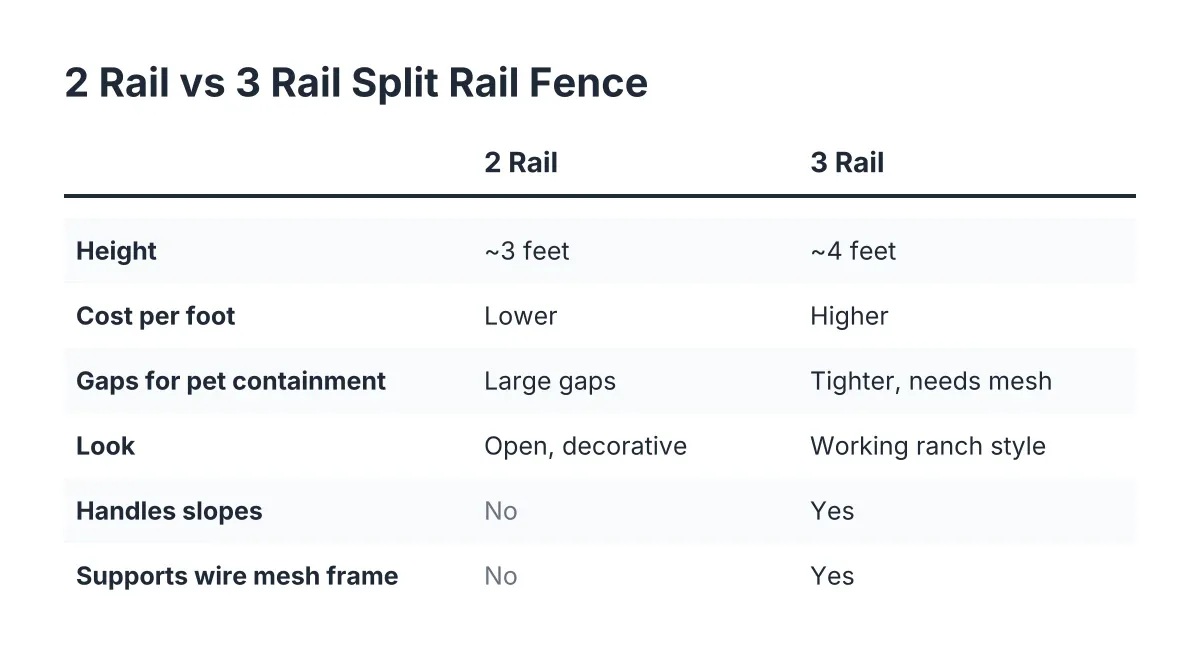
The practical differences between a 2 rail and 3 rail split rail fence are height, visual weight, cost, and what you can attach to them. Here is the short version:
- Height: 2 rail runs around three feet; 3 rail runs around four feet.
- Cost: 3 rail uses roughly half again as much rail material, plus taller posts, so expect a meaningfully higher price per foot.
- Gaps: 2 rail leaves large openings a dog walks through; 3 rail tightens the spacing but still needs mesh for true containment.
- Look: 2 rail reads open and decorative; 3 rail reads like working ranch fencing.
- Slopes: 3 rail handles grade changes more gracefully because the extra rail keeps the fence from looking sparse where the ground drops.
For context on budget, Redfin reports that fence installation costs average around $3,200 in the U.S., varying by material and fence type. Split rail often comes in below the averages for privacy fencing because it uses less material per foot, but rail count, total footage, gates, and ground conditions all move the number.
One more thing worth knowing as you search: typing "2 rail 3 rail" into Google pulls up model train forums alongside fencing pages. You want the fence results. The train hobbyists have their own debate going.
Step 3: Match the Rail Count to Your Property Line Situation
If a boundary question triggered this project, the rail count is only half the decision. Where the fence sits matters more. A split rail fence set clearly inside your line, with the survey to back it up, ends most disputes before they start.
Suppose a homeowner in Ellet has a neighbor questioning where the old chain link used to run. The survey pins are missing, and nobody agrees who owned the fence that fell down. In that scenario, the smart move is to order a new survey, set a 2 rail fence a few inches inside the confirmed line, and keep the paperwork. The open design of 2 rail makes the gesture read as a marker, not a wall, which keeps the temperature down with the neighbor.
Ohio does have line fence law, but it mostly applies to agricultural land, not platted city lots. In Akron neighborhoods, the general rule is simple: build on your own side, and you own the fence. If the dispute is already heated or the survey conflicts with the deed, talk to a surveyor or an attorney before any posts go in. A fence company can set posts precisely where you tell them; it cannot settle a legal boundary for you.
Step 4: Choose Your Split Rail Fence Materials
Cedar is the standard for split rail fence materials in Northeast Ohio, and for good reason. Red cedar resists rot and insects naturally, weathers to a silver-gray that suits older bungalows and newer builds alike, and does not need paint or stain. Pressure-treated pine costs less up front but tends to warp and check as it dries, and it starts out green-tinted.
Vinyl split rail is the third option. It never needs staining and holds its color, but it costs more up front and looks less rustic. If the goal is a classic rural look along a property line, cedar wins. If the goal is zero maintenance for decades, vinyl earns its premium.
Whichever material you pick, pay attention to the posts. End posts are mortised partway through so the finished side looks clean, while line posts are mortised all the way through to accept rails from both directions. A good installer plans the post layout so cut or shortened sections land in the least visible stretch of the yard, and full sections face the street.
Step 5: Plan the Layout, Gates, and Slopes
Walk the fence line before anyone digs. Mark corners, note where gates go, and flag any grade changes. Gates deserve early thought; a three-foot walk gate handles foot traffic, while a mower or future shed delivery may call for a wider double gate.
Slopes change the math. On steeper grades, full-length rails cannot always reach into the post mortises, so post spacing has to shorten to let the rails seat properly. That means more posts per hundred feet on a hilly lot, which affects both the material list and the fence quote. A 3 rail design tends to look better on these sections because the extra rail fills the visual gap where the ground falls away.
In addition, think about Akron's ground. Clay-heavy soil holds water and moves with freeze-thaw cycles, which can heave a shallow-set post out of plumb within a few winters. Posts need to be set deep enough and backfilled correctly for the soil, not just dropped in a minimum-depth hole. This is where local installation experience earns its keep.
Step 6: Get a Clear Fence Estimate Before You Commit
With the rail count, material, and layout decided, you are ready to price the project. A straightforward fence estimate should spell out total footage, rail count, post type and depth, gate hardware, mesh if you are adding it, and who handles utility locates. If a survey is needed, ask whether the installer coordinates with the surveyor or expects you to handle it; getting that answer in writing prevents the hidden-cost surprise later.
Compare quotes on scope, not just the bottom line. A low number that assumes shallow posts in Akron clay is not a bargain; it is a repair bill on a delay. As a general benchmark, HomeAdvisor data shows homeowners typically spend between $1,743 and $4,431 on a new fence installation, averaging $3,059 nationally. Your split rail project may land below that range for a short 2 rail run or above it for a long 3 rail line with mesh and gates.
The Bottom Line on 2 Rail vs 3 Rail
Choose 2 rail when the fence's only job is marking the line with a classic, open look at the lowest cost. Choose 3 rail when you need more height, plan to add mesh for pets, or want a fuller look on sloped ground. Either way, confirm your property line first, pick cedar unless maintenance-free vinyl justifies its cost, and insist on posts set for Akron soil. Get the 2 rail versus 3 rail decision right at the start, and the fence will do its job quietly for decades, which is exactly what a good boundary fence should do.
If you need split rail fence installation, Akron Fence Co can help.
Prefer to talk it through? Call (330) 302-2470 — a quick call is usually the fastest way to get a straight answer for your situation.