
Vinyl Fence Installation Without Digging Post Holes: Akron Alternatives Explained
If you're looking into vinyl fence installation without digging post holes, you've probably seen the ads for no-dig vinyl fence systems and driven posts. The pitch is simple: skip the auger, skip the concrete, have a fence by the weekend. In Akron, though, the ground has a vote. Our clay-heavy soil swells when it's wet and heaves when it freezes, and that changes which no-dig methods hold up and which ones lean over by spring.
This guide walks through the real alternatives step by step. It covers driven anchors, core-drilling into existing concrete, and reinforced posts, plus where traditional dug-and-set posts are still the right call. By the end, you should know which approach fits your yard, your property line situation, and your budget.
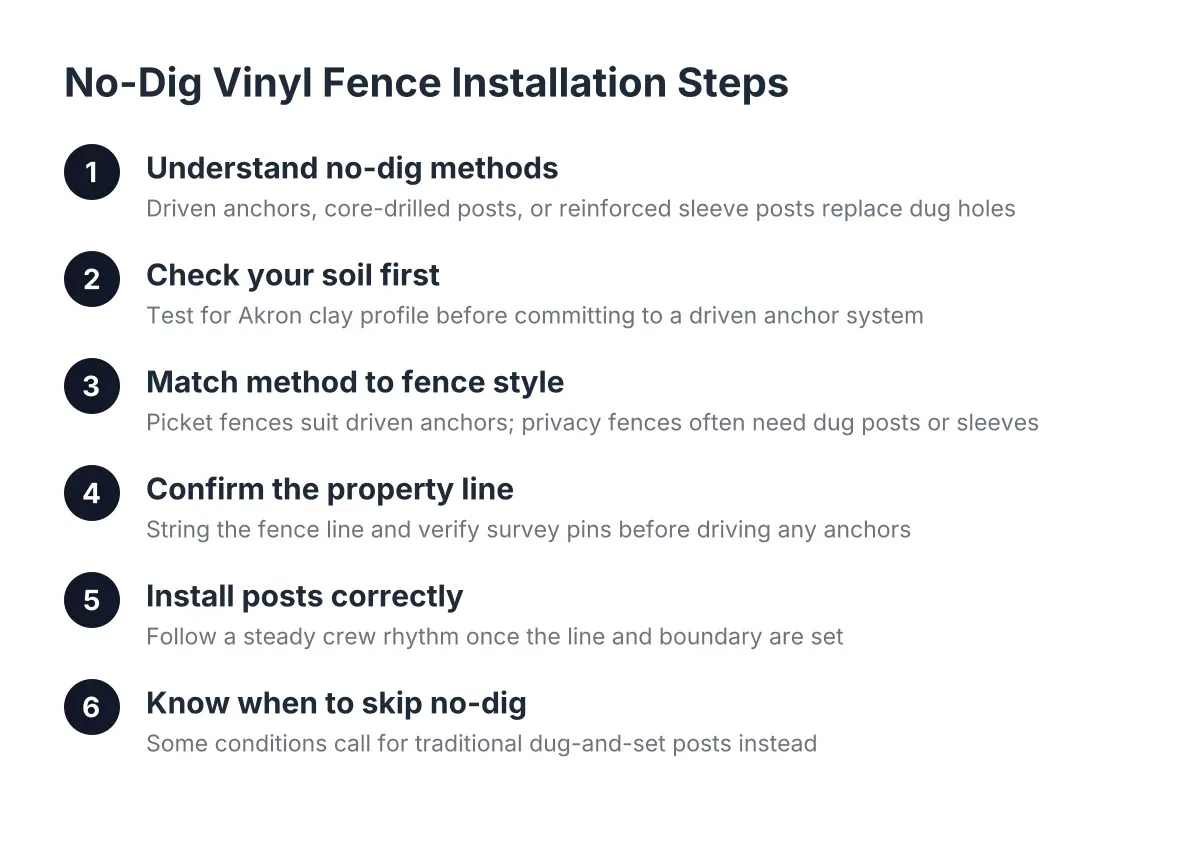
Step 1: Understanding No-Dig Vinyl Fence Installation
A no-dig vinyl fence replaces the dug hole and concrete footing with a steel anchor or spike that gets driven straight into the ground. The vinyl post then sleeves over that anchor. No auger, no concrete truck, and far less disturbed soil along the property line.
That last part matters more than most people think. Vinyl posts are the foundation of the whole fence. The panels, rails, and gate all depend on those posts staying plumb for years. A driven anchor can do that job, but only if the soil grips it and the frost doesn't push it around.
Here are the main ways to get vinyl fence installation without post holes dug the traditional way:
- Driven steel anchors or spikes. A steel spike is pounded into the ground, and the vinyl post slides over it. Fast and clean in the right soil.
- Core-drilled posts in existing concrete. A core drill cuts a neat round hole through a patio, walkway, or driveway edge, and the post is set in that hole. The surface stays intact instead of getting broken out with a jackhammer.
- Reinforced sleeve posts. A metal pipe is set first, and the vinyl post sleeves over it. This works in tight spots, like butting up against an existing fence or working around tree roots where a full hole can't be dug.
Each one skips the classic post hole. None of them skips the physics.
Step 2: Check Your Soil Before You Commit to a Driven System
Driven no-dig anchors work best in soil that is firm, well drained, and consistent. Much of Akron is clay, and clay complicates things. When clay freezes, it expands and can grab a shallow anchor and lift it. When it thaws and gets saturated, it loosens its grip. A post that was straight in October can lean by March.
Therefore, do a simple test before you order anything. Push a long screwdriver or rebar stake into the ground along your planned fence line after a rain. If it sinks easily for the first foot and then hits dense, sticky resistance, you have the classic Akron clay profile. Driven anchors can still work there, but they need to be the longer, heavier style, and even then a privacy fence may be asking too much of them.
One rule from the fence trade applies here no matter the method: a post set by tamping loose dirt back around it, with no concrete or foam footing and no engineered anchor, is not acceptable work. If a quote describes the install that way, keep asking questions.
Step 3: Match the No-Dig Method to Your Fence Style
Not every vinyl fence style suits an installation without dug footings. Wind load is the deciding factor. A solid six-foot privacy fence acts like a sail. A short picket fence barely catches the wind at all.
Use this as a working guide:
- Vinyl picket fence, 3 to 4 feet tall: Good candidate for driven anchors. Low wind load, light panels.
- Open-style vinyl or spaced pickets: Also reasonable, since wind passes through.
- Full vinyl privacy fence, 6 feet tall: Risky on driven anchors in clay. Most installers in Northeast Ohio will steer you to dug posts set in concrete, or to reinforced steel-sleeved posts, for solid panels.
- Fence lines crossing a patio or walkway: Core drilling is the answer. The drill leaves a clean hole, the surface stays whole, and the post gets a real footing inside it.
In addition, think about your gate. Gates swing, slam, and carry weight on hinges. Even on a mostly no-dig run, setting the gate posts in concrete is cheap insurance against a gate that drags by next summer.
Step 4: Lay Out the Fence Line and Confirm the Property Line First
Before any anchor gets driven, set stakes at both ends of each run and stretch a string line between them. That string keeps every post on the same straight line, which matters twice as much with driven anchors because you can't nudge them sideways the way you can adjust a post in wet concrete.
For a lot of Akron homeowners, this step is really about the neighbor. If your survey pins are missing, or the old fence fell down and nobody agrees whose it was, do not guess. A fence set three inches over the line can turn a quiet street into a cold war. Suppose a homeowner in Ellet closes on a new build in April, wants a vinyl privacy fence before the dog arrives in June, and finds only one corner pin. In that scenario, the smart move is to locate or re-establish the pins first, then set the fence clearly on their own side, with the string line referenced off the confirmed boundary.
A good local fence company will talk through property line placement, setbacks, and permits before quoting, and will tell you plainly when a survey is worth the cost. Akron's mix of older platted city lots and newer suburban parcels means setback norms vary block to block, so confirm with the city before you build. Also call 811 for utility marking; no-dig does not mean no underground risk.
Step 5: Install Posts Without Digging, the Right Way
With the line strung and the boundary confirmed, the install itself follows a steady rhythm. Here is how a typical crew approaches a no-dig vinyl fence installation:
- Set the end posts first. Drive the anchors at both ends of the run, check them for plumb in both directions, and sleeve the vinyl posts over them.
- Work off the string line. Mark each intermediate post location along the string at the panel spacing your system calls for.
- Drive each anchor plumb. Check with a level every few blows. A driven anchor that goes in crooked stays crooked.
- Sleeve and secure the posts. Slide each vinyl post over its anchor and fasten it per the system's hardware.
- Fit the rails and panels. Rails can be cut to length so they fit snugly between posts, then secured with the system's screws. Side strips on the posts hold grooved pickets in place once the rails are set.
- Handle slopes smartly. On a sloped section, you can reverse the direction you build the panel so pickets don't slide downhill as you insert them.
- Hang the gate last. Confirm the gate posts are rock solid before mounting hinges and latch.
For core-drilled sections, the sequence is the same except the anchor step: the crew drills through the concrete, sets the post in the cored hole with a proper footing, and the patio or walkway around it stays untouched.
Step 6: Weigh Cost, Honestly
Vinyl fence installation cost depends on linear footage, fence height, style, gates, and how the posts get set. No-dig systems save labor on digging and concrete, but the engineered anchors themselves cost more than a bag of concrete, so the savings per foot are smaller than the marketing suggests. Core drilling adds equipment time but avoids the bigger cost of breaking and repouring concrete.
For context, HomeAdvisor data shows homeowners typically spend between $1,743 and $4,431 on a new fence installation, averaging $3,059 nationally. Redfin reports a similar national average around $3,200, varying by material and fence type. A full vinyl perimeter on a new-build lot usually lands above those averages because of the footage involved. Get a written fence estimate that spells out the post-setting method, and if the budget is tight, ask about payment options; plenty of homeowners searching for a fence company with financing near me, from Akron down through fence companies Canton Ohio shoppers compare, find that spreading the cost makes a better install affordable.
Step 7: Know When to Skip No-Dig and Set Posts the Traditional Way
Can I install a vinyl fence myself with a no-dig kit? For a short picket run in firm soil, yes, a capable homeowner can. For a six-foot privacy fence on Akron clay, a long sloped run, or any fence sitting close to a disputed property line, bring in a professional. The freeze-thaw cycles here punish shortcuts, and a leaning fence on a contested boundary creates exactly the fight you were trying to avoid.
The honest trade-off is this: installing a vinyl fence without digging saves time and mess, but dug posts set in concrete below the frost line remain the most durable choice for tall or solid fences in this climate. No-dig earns its place on light, open styles, on hard surfaces where core drilling preserves the concrete, and in tight spots where a reinforced steel sleeve post solves a problem a shovel can't.
Whichever route you choose, get the property line settled first, insist on a clear estimate that names the post-setting method, and build once, on your side of the line, where it can stand for twenty years without an argument.
If you need vinyl fence installation, Akron Fence Co can help.
Prefer to talk it through? Call (330) 302-2470 — a quick call is usually the fastest way to get a straight answer for your situation.